
Stanford and NYU Researchers Release First Toolkit to Measure the Impact of Phone-Free School Policies
Stanford and NYU Researchers Release First Toolkit to Measure the Impact of Phone-Free School Policies
Eighteen States and D.C. Have Implemented “Bell-to-Bell” School Phone-Use Policies In The Past Year

Today, leading university social technology labs–Stanford Social Media Lab, led by Jeff Hancock and Sunny Xun Liu and Tech and Society Lab at NYU Stern, led by Jonathan Haidt and Zach Rausch–have announced the release of a first-of-its-kind toolkit to help K-12 schools evaluate the effectiveness of their phone policies.
Developed jointly, the Toolkit for Assessing Phones in Schools (TAPS) is a free, ready-to-use evaluation toolkit designed specifically for teachers, administrators, students, parents and policy makers looking to measure the effects of phone policies on student-, family- and school-level outcomes.
TAPS was created in response to the rapid passage and implementation of school phone policies across the United States and abroad (currently, 37 states have implemented some phone-free legislation, with 18 states and the District of Columbia mandating a bell-to-bell phone-free policy), and provides a flexible framework for stakeholders and decision makers to collect essential data to evaluate the effectiveness of those policies.
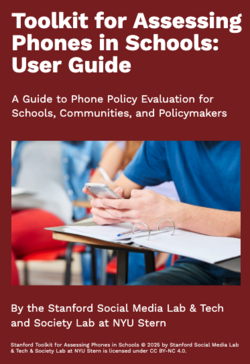
The toolkit is available with two primary survey options: ready-made surveys (available now) and custom surveys (coming out in September 2025). Ready-made surveys provide an easier, more convenient approach to measure changes in mental health, tech use, school climate, and more. The custom surveys will enable schools to select measures that are more specific to their needs. In all, there are six pre-made surveys, designed for students (short-form and long-form), teachers (short-form and long-form), administrators, and parents.
“Measuring the impact of these large-scale phone policy interventions on students, families and schools is so important,” said Sunny Liu, Research Director for the Stanford Social Media Lab. “Understanding the breadth of schools and heterogeneity of students was critical to the design of the toolkit. We structured TAPS to be scientifically rigorous, while maintaining flexibility and ease-of-use for its implementation across a wide range of school settings and circumstances.”
Zach Rausch, Chief Researcher at the Tech and Society Lab at NYU, who collaborated with Dr. Liu in creating TAPS, added, “New phone-free policies are sweeping schools across the nation. The potential upside for students and teachers is huge – but there is currently no accessible systematic survey to track if and what the policies are actually delivering. That’s why we built this tool: to turn a patchwork of policies into real data that everyone can benefit from.”
In the coming months, the TAPS team will publish a measurement database to enable individuals to create tailored evaluation surveys that meet their specific needs and goals. This database will comprise a wide range of validated survey measures, including school climate, student behavior, technology use, physical and mental health, and psychological wellbeing, among others.
Furthermore, Stanford Social Media Lab and Tech and Society Lab at NYU Stern will continue to develop and share resources, such as survey administration information and webinars, and a data analysis help center, to support schools in implementing surveys and analyzing the data.
ABOUT STANFORD SOCIAL MEDIA LAB
The Stanford Social Media Lab works on understanding psychological and interpersonal processes in social media. Its mission is to enhance human health and well-being by producing and disseminating pivotal research aimed at reestablishing trust in the era of social media and AI.
ABOUT TECH AND SOCIETY LAB AT NYU STERN
The Tech and Society Lab at NYU Stern generates research to help the public make sense of and navigate the rapid, unprecedented social and technological changes reshaping our lives. It is home to social psychologist Jonathan Haidt, author of the #1 New York Times Best-seller, “The Anxious Generation - How the Great Rewiring of Childhood is Causing an Epidemic of Mental Illness.”

