
Agents of Influence
Agents of Influence
Improving Youth Resilience to Misinformation through a Gamified Digital Media Literacy Intervention
Teaching teens to spot the fake
Misinformation has become one of the defining threats to American public life, feeding polarization, vaccine hesitancy, and eroding trust in democratic institutions. Social media platforms make it easy for false claims to spread quickly and mutate as they travel. Young people are especially exposed: because so many teens encounter news incidentally while scrolling rather than seeking it out deliberately, they tend to absorb claims without evaluating them critically. National research has found that a majority of adolescents struggle to distinguish credible journalism from deceptive content, often relying on superficial cues rather than verification skills.
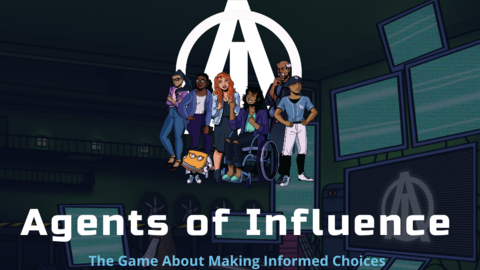
Traditional media literacy training has not kept pace with how young people actually consume information. Most existing interventions were built for adults and delivered through multi-hour workshops or self-paced online courses, formats that rarely hold a teenager's attention. Agents of Influence, developed by Alterea Inc. and evaluated by Tech Impact and Policy Center’s Postdoctoral Scholar, Angela Lee, takes a different approach: an online narrative game that teaches middle and high school students to fact-check, trace the origins of images, and evaluate the credibility of sources, all inside a spy-themed adventure rather than a lecture.
Inside the game
Set at the fictional Virginia Hall High School, the game casts players as members of a new spy organization who must outmaneuver a shadowy disinformation network. Along the way, students practice their skills through three linked mini-games: a conversation simulator that rewards respectful, fallacy-free argument; a research mission (guided by an in-game AI assistant) that trains players to verify claims across sources; and a document-analysis challenge that tests their judgment of what is true or false in a given piece of media.
What the research found
Our study followed 93 students, ages 11 to 14, across California public, private, and home schools as they played the game and completed literacy assessments before and after each episode. The intervention produced measurable gains: students' ability to tell true headlines from false ones rose sharply after the first episode, and their broader media literacy skills, including fact-checking, reverse-image searches, and evaluating source credibility, improved as well. Students also became more confident in their own ability to spot misinformation and reported enjoying the experience. The authors note that some gains softened by the second episode, a finding they flag as a direction for future study alongside plans for a larger, randomized controlled trial.
Why it matters
Gamified, narrative-driven interventions may offer a more durable path to building youth resilience against misinformation than conventional training, precisely because they meet students where their attention already is.