Security

FSI scholars produce research aimed at creating a safer world and examing the consequences of security policies on institutions and society. They look at longstanding issues including nuclear nonproliferation and the conflicts between countries like North and South Korea. But their research also examines new and emerging areas that transcend traditional borders – the drug war in Mexico and expanding terrorism networks. FSI researchers look at the changing methods of warfare with a focus on biosecurity and nuclear risk. They tackle cybersecurity with an eye toward privacy concerns and explore the implications of new actors like hackers.

Along with the changing face of conflict, terrorism and crime, FSI researchers study food security. They tackle the global problems of hunger, poverty and environmental degradation by generating knowledge and policy-relevant solutions. 

image of encina hall at stanford with blue overlay and headshots of Valerie Shen of Third Way and Aman Nair of CIS

Join us on Tuesday, March 15th from 12 PM - 1 PM PT for “Global Perspectives on Crypto-Asset Regulation” featuring Valerie Shen of Third Way, Aman Nair of the Centre for Internet and Society, in conversation with Kelly Born of the Hewlett Foundation. This weekly seminar series is jointly organized by the Cyber Policy Center’s Program on Democracy and the Internet and the Hewlett Foundation’s Cyber Initiative.

About The Seminar: 

Since the launch of Bitcoin, the world’s first cryptocurrency, just over 10 years ago, the cryptocurrency market has grown to over $2.4 trillion, tripling in value in the last year alone. In addition to its many purported benefits, cryptocurrency poses challenges to the environment, privacy, financial stability, and more. Cryptocurrencies have played an increasing role in the rise of cybercrimes, including ransomware and money laundering. In light of this the Biden Administration, European Union, Indian government, and countries around the world are actively exploring regulatory options to address these and other concerns. On March 15 join Aman Nair of India’s Centre for Internet and Society and Valerie Shen of Third Way, in conversation with Kelly Born of the Hewlett Foundation, to discuss the use cases and limitations of crypto-assets, compare relevant regulatory regimes from around the world, discuss the debate over the proper legal and regulatory framework for crypto-enabled crime, and explore how to govern crypto-assets while supporting widespread financial stability.

Speakers:

Image
Valerie Shen
Valerie Shen directs Third Way's National Security Program and Cyber Enforcement Initiative, a nonpartisan dedicated to strengthening governments’ abilities to identify, stop, and bring malicious cyber actors to justice. Third Way’s National Security program focuses on cutting edge policy ideas and to keep our country safe  against foreign adversaries in the ever-changing and developing cyber ecosystem.  Valerie served as the Chief National Security Counsel to the House Oversight and Reform Committee for Chairman Elijah E. Cummings. She oversaw all national security and homeland security matters from cyber operations and federal law enforcement, to counterterrorism, defense, and counterintelligence. Valerie was also an investigative counsel for the Select Committee on Benghazi and the Senate Homeland Security and Governmental Affairs Committee. Valerie was also a post-doctoral fellow at Georgetown University’s Center for National Security focusing on China’s social media and influence operations. Valerie earned her J.D. from Georgetown University Law Center and her bachelor's degree in Politics from Pomona College.

Image
Aman Nair
Aman Nair is a policy researcher at the Centre for Internet and Society, India (CIS). He leads the financial technologies research agenda at CIS and has been focusing on research on crypto-assets and blockchain technology. He also works on issues of data governance and access to justice. 

-
picture of Ukraine flag background

Join us Friday March 4th at 2 PM Pacific for State Media, Social Media, and the Conflict in Ukraine, a conversation on the role of state and social media in the conflict in Ukraine. 

As the war intensifies, the propaganda battles related to the conflict are already in full force. European governments have attempted to ban RT and Sputnik from platforms operating in the region. Facebook and Twitter have taken an array of actions to demote, label, and demonetize content from these sources. As is so often the case, precedents are being created in wartime that could have dramatic implications for the ways state-sponsored media will be regulated even outside these extreme contexts. To discuss what is happening and what the challenges are, this webinar brings together scholars and experts from the Stanford Cyber Policy Center, social media platforms, and elsewhere in the field.

SPEAKERS:

  • Mike McFaul, Director of the Freeman Spogli Institute for International Studies, and former U.S. Ambassador to the Russian Federation.
  • Nate Persily, Co-director, Cyber Policy Center and James B. McClatchy Professor of Law at Stanford Law School.
  • Marietje Schaake, International Policy Director at the Cyber Policy Center and former Member of European Parliament.
  • Renee DiResta, Research Manager at the Stanford Internet Observatory.
  • Alex Stamos, Director of the Stanford Internet Observatory and former Chief Security Officer of Facebook.
  • Nathaniel Gleicher, Head of Security Policy at Meta.
  • Alicia Wanless, Director of the Partnership for Countering Influence Operations at the Carnegie Endowment for International Peace.
  • Yoel Roth, Head of Site Integrity at Twitter.

Encina Hall
616 Jane Stanford Way
Stanford, CA 94305-6055

0
Senior Fellow, Freeman Spogli Institute for International Studies
Ken Olivier and Angela Nomellini Professor of International Studies, Department of Political Science
Peter and Helen Bing Senior Fellow, Hoover Institution
mcfaul_headshot_2025.jpg PhD

Michael McFaul is the Ken Olivier and Angela Nomellini Professor of International Studies in Political Science, Senior Fellow at the Freeman Spogli Institute for International Studies, and the Peter and Helen Bing Senior Fellow at the Hoover Institution, all at Stanford University. He joined the Stanford faculty in 1995 and served as FSI Director from 2015 to 2025. He is also an international affairs analyst for MSNOW.

McFaul served for five years in the Obama administration, first as Special Assistant to the President and Senior Director for Russian and Eurasian Affairs at the National Security Council at the White House (2009-2012), and then as U.S. Ambassador to the Russian Federation (2012-2014).

McFaul has authored ten books and edited several others, including, most recently, Autocrats vs. Democrats: China, Russia, America, and the New Global Disorder, as well as From Cold War to Hot Peace: An American Ambassador in Putin’s Russia, (a New York Times bestseller) Advancing Democracy Abroad: Why We Should, How We Can; and Russia’s Unfinished Revolution: Political Change from Gorbachev to Putin.

He is a recipient of numerous awards, including an honorary PhD from Montana State University; the Order for Merits to Lithuania from President Gitanas Nausea of Lithuania; Order of Merit of Third Degree from President Volodymyr Zelenskyy of Ukraine, and the Dean’s Award for Distinguished Teaching at Stanford University. In 2015, he was the Distinguished Mingde Faculty Fellow at the Stanford Center at Peking University.

McFaul was born and raised in Montana. He received his B.A. in International Relations and Slavic Languages and his M.A. in Soviet and East European Studies from Stanford University in 1986. As a Rhodes Scholar, he completed his D. Phil. in International Relations at Oxford University in 1991. 

CV
Date Label
0
renee-diresta.jpg

Renée DiResta is the former Research Manager at the Stanford Internet Observatory. She investigates the spread of malign narratives across social networks, and assists policymakers in understanding and responding to the problem. She has advised Congress, the State Department, and other academic, civic, and business organizations, and has studied disinformation and computational propaganda in the context of pseudoscience conspiracies, terrorism, and state-sponsored information warfare.

You can see a full list of Renée's writing and speeches on her website: www.reneediresta.com or follow her @noupside.


Former Research Manager, Stanford Internet Observatory
0
rsd18_083_0009a.jpg

Alex Stamos is a cybersecurity expert, business leader and entrepreneur working to improve the security and safety of the Internet. Stamos was the founding director of the Stanford Internet Observatory at the Cyber Policy Center, a part of the Freeman Spogli Institute for International Studies. He is currently a lecturer, teaching in both the Masters in International Policy Program and in Computer Science.

Prior to joining Stanford, Alex served as the Chief Security Officer of Facebook. In this role, Stamos led a team of engineers, researchers, investigators and analysts charged with understanding and mitigating information security risks to the company and safety risks to the 2.5 billion people on Facebook, Instagram and WhatsApp. During his time at Facebook, he led the company’s investigation into manipulation of the 2016 US election and helped pioneer several successful protections against these new classes of abuse. As a senior executive, Alex represented Facebook and Silicon Valley to regulators, lawmakers and civil society on six continents, and has served as a bridge between the interests of the Internet policy community and the complicated reality of platforms operating at billion-user scale. In April 2017, he co-authored “Information Operations and Facebook”, a highly cited examination of the influence campaign against the US election, which still stands as the most thorough description of the issue by a major technology company.

Before joining Facebook, Alex was the Chief Information Security Officer at Yahoo, rebuilding a storied security team while dealing with multiple assaults by nation-state actors. While at Yahoo, he led the company’s response to the Snowden disclosures by implementing massive cryptographic improvements in his first months. He also represented the company in an open hearing of the US Senate’s Permanent Subcommittee on Investigations.

In 2004, Alex co-founded iSEC Partners, an elite security consultancy known for groundbreaking work in secure software development, embedded and mobile security. As a trusted partner to world’s largest technology firms, Alex coordinated the response to the “Aurora” attacks by the People’s Liberation Army at multiple Silicon Valley firms and led groundbreaking work securing the world’s largest desktop and mobile platforms. During this time, he also served as an expert witness in several notable civil and criminal cases, such as the Google Street View incident and pro bono work for the defendants in Sony vs George Hotz and US vs Aaron Swartz. After the 2010 acquisition of iSEC Partners by NCC Group, Alex formed an experimental R&D division at the combined company, producing five patents.

A noted speaker and writer, he has appeared at the Munich Security Conference, NATO CyCon, Web Summit, DEF CON, CanSecWest and numerous other events. His 2017 keynote at Black Hat was noted for its call for a security industry more representative of the diverse people it serves and the actual risks they face. Throughout his career, Alex has worked toward making security a more representative field and has highlighted the work of diverse technologists as an organizer of the Trustworthy Technology Conference and OURSA.

Alex has been involved with securing the US election system as a contributor to Harvard’s Defending Digital Democracy Project and involved in the academic community as an advisor to Stanford’s Cybersecurity Policy Program and UC Berkeley’s Center for Long-Term Cybersecurity. He is a member of the Aspen Institute’s Cyber Security Task Force, the Bay Area CSO Council and the Council on Foreign Relations. Alex also serves on the advisory board to NATO’s Collective Cybersecurity Center of Excellence in Tallinn, Estonia.

Former Director, Stanford Internet Observatory
Lecturer, Masters in International Policy
Lecturer, Computer Science
Date Label
0
marietje.schaake

Marietje Schaake is a non-resident Fellow at Stanford’s Cyber Policy Center and at the Institute for Human-Centered AI. She is a columnist for the Financial Times and serves on a number of not-for-profit Boards as well as the UN's High Level Advisory Body on AI. Between 2009-2019 she served as a Member of European Parliament where she worked on trade-, foreign- and tech policy. She is the author of The Tech Coup.


Non-Resident Fellow, Cyber Policy Center
Fellow, Institute for Human-Centered Artificial Intelligence
Date Label
Yoel Roth
Nathaniel Gleicher
Alicia Wanless
Panel Discussions

Image
Facebook's Faces event flyer on blue and red background with photo of Chinmayi Arun
Join us on Tuesday, March 1 from 12 PM - 1 PM PT for a panel discussion on “Facebook’s Faces” featuring Chinmayi Arun, Resident Fellow at the Yale Law School in conversation with Nate Persily of the Stanford Cyber Policy Center. This weekly seminar series is jointly organized by the Cyber Policy Center’s Program on Democracy and the Internet and the Hewlett Foundation’s Cyber Initiative.

About The Seminar: 

Scholarship about social media platforms discusses their relationship with states and users. It is time to expand this theorization to account for differences among states, the varying influence of different publics and the internal complexity of companies. Viewing Facebook’s relationships this way includes less influential states and publics that are otherwise obscured. It reveals that Facebook engages with states and publics through multiple, parallel regulatory conversations, further complicated by the fact that Facebook itself is not a monolith. Arun argues that Facebook has many faces – different teams working towards different goals, and engaging with different ministries, institutions, scholars and civil society organizations. Content moderation exists within this ecosystem.
 
This account of Facebook’s faces and relationships shows that less influential publics can influence the company through strategic alliances with strong publics or powerful states. It also suggests that Facebook’s carelessness with a seemingly weak state or a group, may affect its relationship with a strong public or state that cares about the outcome.

To be seen as independent and legitimate, the Oversight Board needs to show its willingness to curtail Facebook’s flexibility in its engagement with political leaders where there is a real risk of harm. This essay hopes to show that Facebook’s fear of short-term retaliation from some states should be balanced out by accounting for the long-term reputational gains with powerful publics and powerful states who may appreciate its willingness to set profit-making goals aside in favor of human flourishing.

About the Speakers:

Image
Chinmayi Arun
Chinmayi Arun is a resident fellow of the Information Society Project at Yale Law School, and an affiliate of the Berkman Klein Center of Internet & Society at Harvard University. She has served on the faculties of two of the most highly regarded law schools in India for over a decade, and was the founder Director of the Centre for Communication Governance at National Law University Delhi. She has been a Human Rights Officer with the United Nations and is a member of the United Nations Global Pulse Advisory Group on the Governance of Data and AI, and of UNESCO India’s Media Freedom Advisory Group.

Chinmayi serves on the Global Network Initiative Board, and is an expert affiliated with the Columbia Global Freedom of Expression project. She has been consultant to the Law Commission of India and member of the Indian government’s multi stakeholder advisory group for the India Internet Governance Forum in the past.

Image
Nate Persily
Nathaniel Persily is the James B. McClatchy Professor of Law at Stanford Law School, with appointments in the departments of Political Science, Communication, and FSI.  Prior to joining Stanford, Professor Persily taught at Columbia and the University of Pennsylvania Law School, and as a visiting professor at Harvard, NYU, Princeton, the University of Amsterdam, and the University of Melbourne. Professor Persily’s scholarship and legal practice focus on American election law or what is sometimes called the “law of democracy,” which addresses issues such as voting rights, political parties, campaign finance, redistricting, and election administration. He has served as a special master or court-appointed expert to craft congressional or legislative districting plans for Georgia, Maryland, Connecticut, New York, North Carolina, and Pennsylvania.  He also served as the Senior Research Director for the Presidential Commission on Election Administration. His current work, for which he has been honored as a Guggenheim Fellow, Andrew Carnegie Fellow, and a Fellow at the Center for Advanced Study in the Behavioral Sciences, examines the impact of changing technology on political communication, campaigns, and election administration.  He is codirector of the Stanford Cyber Policy Center, Stanford Program on Democracy and the Internet, and the Stanford-MIT Healthy Elections Project, which supported local election officials in taking the necessary steps during the COVID-19 pandemic to provide safe voting options for the 2020 election. He is also a member of the American Academy of Arts and Sciences, and a commissioner on the Kofi Annan Commission on Elections and Democracy in the Digital Age.


Seminars
-

Image
collage showing cory doctorow, Dr. Tomicah Tillemann and Michelle Finck

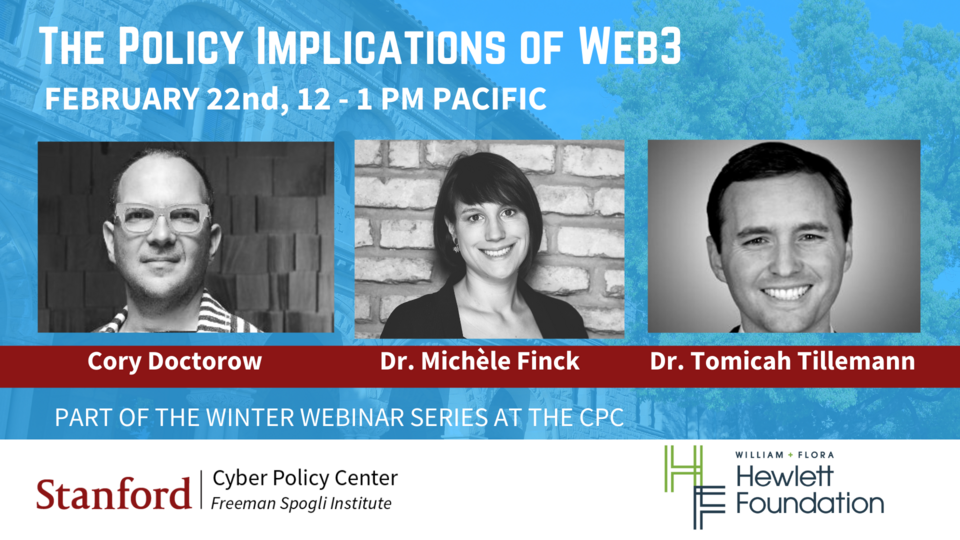
Join us on Tuesday, February 22 from 12 PM - 1 PM PT for a panel discussion on “The Policy Implications of Web3”, featuring Tomicah Tillemann of KRH Partners, Cory Doctorow of Craphound.com, and Michèle Finck of the University of Tübinge in conversation with Marietje Schaake of the Stanford Cyber Policy Center. This weekly seminar series is jointly organized by the Cyber Policy Center’s Program on Democracy and the Internet and the Hewlett Foundation’s Cyber Initiative.

The year 2021 marked an important moment for web3. Proponents believe the potential of web3 to democratize, decentralize and improve the internet is huge. Others argue that evangelists have yet to deliver results, and that web3 will inevitably tend towards centralization. Few however have explored the policy and political implications of the concept: how should regulators approach a potential web3 explosion? How should lawmakers think about the wider internet infrastructure? Is web3 an opportunity to reimagine the internet, or will it present even more challenges to policymakers? This webinar will explore these angles and foster a reflection on public policy by leading technologists and academics. The session is open to the public, but registration is required.

ABOUT THE SPEAKERS:


Image
cory doctorow
Cory Doctorow (craphound.com) is a science fiction author, activist and journalist. He is the author of many books, most recently Radicalized and Walkaway. He maintains a daily blog at Pluralistic.net. He works for the Electronic Frontier Foundation, is a MIT Media Lab Research Affiliate, a Visiting Professor of Computer Science at Open University, a Visiting Professor of Practice at the University of North Carolina’s School of Library and Information Science and co-founded the UK Open Rights Group. In 2020, he was inducted into the Canadian Science Fiction and Fantasy Hall of Fame.

Image
Michele Finck
Dr. Michèle Finck is Professor of Law and Artificial Intelligence at the University of Tübingen, an Affiliated Fellow at the Max Planck Institute for Innovation and Competition in Munich and the Centre for Blockchain Technologies at University College London as well as a Visiting Professor at LUISS University in Rome. She previously worked at the University of Oxford and the London School of Economics.


Image
tomicah tillemann
Dr. Tomicah Tillemann is a partner and Global Chief Policy Officer at KRH Partners, a new crypto venture fund led by former a16z General Partner Katie Haun, where he builds public policy architecture to support the next generation of the Internet. Until recently, he was the Global Head of Policy for an arm of Andreessen Horowitz. He worked in collaboration with the Rockefeller Foundation, the World Bank, MIT, and governments around the world to develop a new generation of open source technology platforms to power the public sector. He also oversaw the work of the Blockchain Trust Accelerator and the Responsible Asset Allocator Initiative.

Image
Marietje Schaake
Marietje Schaake (Moderator) is international policy director at Stanford University Cyber Policy Center and international policy fellow at Stanford’s Institute for Human-Centered Artificial Intelligence. Between 2009 and 2019, Marietje served as a Member of European Parliament for the Dutch liberal democratic party where she focused on trade, foreign affairs, and technology policies. Marietje is an (Advisory) Board Member with a number of nonprofits including MERICS, ECFR, ORF and AccessNow. She writes a monthly column for the Financial Times and a bi-weekly column for the Dutch NRC newspaper.

Seminars
-

Image
alessandro vecchiato

Join us on Tuesday, February 1st from 12 PM - 1 PM PT for Algorithmic Newsfeeds and Elections featuring one of our postdoctoral scholars, Alessandro Vecchiato. This weekly seminar series is jointly organized by the Cyber Policy Center’s Program on Democracy and the Internet and the Hewlett Foundation’s Cyber Initiative.

While personalization algorithms are ubiquitous online, their impact on public opinion and voting behavior is still largely unknown. This talk looks at this question by presenting results from a globally replicable, lab-in-the-field experiment with a custom-developed news app. We evaluate the impact of personalized news feed on news consumption, public opinion, turnout, and voting behavior. The results show that personalization significantly skews the news consumption of politically extreme users while allowing most other users to maintain a moderate news diet. However, personalized news feeds are shown to reinforce pre-existing beliefs for all users, including a demobilizing effect for unlikely voters. While our effects are small due to design constraints, our findings call for more transparency and regulation on platforms.

The session is open to the public, but registration is required.


ABOUT THE SPEAKERS:

Image
Alessandro Vecchiato
Alessandro Vecchiato is a postdoctoral fellow at the Program on Democracy and the Internet at Stanford University. He received his Ph.D. in Politics from New York University in May 2019. His work looks at internet technologies' role in shaping political beliefs and electoral outcomes. In his dissertation, he uses primarily experimental methods to study how algorithmic personalization in social media news feeds affects the beliefs and preferences of voters. In other work, he investigated how internet-mediated communication through social media has affected politicians' relationships with voters.


Image
Nate Persily
Nathaniel Persily is the James B. McClatchy Professor of Law at Stanford Law School, with appointments in the departments of Political Science, Communication, and FSI.  Prior to joining Stanford, Professor Persily taught at Columbia and the University of Pennsylvania Law School, and as a visiting professor at Harvard, NYU, Princeton, the University of Amsterdam, and the University of Melbourne. Professor Persily’s scholarship and legal practice focus on American election law or what is sometimes called the “law of democracy,” which addresses issues such as voting rights, political parties, campaign finance, redistricting, and election administration. He has served as a special master or court-appointed expert to craft congressional or legislative districting plans for Georgia, Maryland, Connecticut, New York, North Carolina, and Pennsylvania.  He also served as the Senior Research Director for the Presidential Commission on Election Administration. His current work, for which he has been honored as a Guggenheim Fellow, Andrew Carnegie Fellow, and a Fellow at the Center for Advanced Study in the Behavioral Sciences, examines the impact of changing technology on political communication, campaigns, and election administration.  He is codirector of the Stanford Cyber Policy Center, Stanford Program on Democracy and the Internet, and the Stanford-MIT Healthy Elections Project, which supported local election officials in taking the necessary steps during the COVID-19 pandemic to provide safe voting options for the 2020 election. He is also a member of the American Academy of Arts and Sciences, and a commissioner on the Kofi Annan Commission on Elections and Democracy in the Digital Age.

Seminars
-

Image
image of Jamal Greene, columbia law professor on blue background advertising january 18th seminar

Join us on Tuesday, January 18 from 12 PM - 1 PM PST for Free Speech on Public Platforms featuring Professor Jamal Greene of Columbia Law School in conversation with Daphne Keller, Director of the Program on Platform Regulation at the CPC. This weekly seminar series is jointly organized by the Cyber Policy Center’s Program on Democracy and the Internet and the Hewlett Foundation’s Cyber Initiative. 

It is commonly assumed that social media companies owe their freedom to moderate solely to their status as private actors. This seminar explores the adequacy of that assumption by considering the hypothetical construct of a state-run social media platform. Jamal Greene argues that the categorical nature of First Amendment norms leave the doctrine ill-equipped to order regulation of such a platform, and that international human rights norms, while less categorical, remain immature in this space. Greene suggests that the most promising area of legal intervention would address the development of procedural rather than substantive norms.

Speaker:

Jamal Greene is the Dwight Professor of Law at Columbia Law School, where he teaches courses in constitutional law, comparative constitutional law, and the law of the political process. He is the author of How Rights Went Wrong: Why Our Obsession With Rights Is Tearing America Apart, as well as numerous articles and book chapters on constitutional law and theory. He is also a co-chair of the Oversight Board, an independent body that reviews content moderation decisions on Facebook and Instagram. He served as a law clerk to the Hon. Guido Calabresi on the U.S. Court of Appeals for the Second Circuit and for the Hon. John Paul Stevens on the U.S. Supreme Court. He earned his J.D. from Yale Law School and his A.B. from Harvard College.

-

Image
cloud governance event with speaker photos of kelly born, marietje schaake

Join us for our winter seminar series starting Tuesday, January 11 from 12 PM - 1 PM PST.  The first in the session is Cloud Governance Challenges and features leaders from the Carnegie Endowment’s Cloud Governance Project and Marietje Schaake of the Stanford Cyber Policy Center, in conversation with Kelly Born of the Hewlett Foundation. This weekly seminar series is jointly organized by the Cyber Policy Center’s Program on Democracy and the Internet and the Hewlett Foundation’s Cyber Initiative.

Central to the ongoing digital transformation is the growth of cloud computing, which is enabling remarkable gains in efficiency, innovation, and connectivity around the world. However, the cloud also accentuates many preexisting digital policy challenges and brings to the fore new ones. It increases the consequences of disruption resulting from cyberattacks and natural disasters, and raises the stakes associated with ensuring equitable access to the digital environment. It also creates some new challenges associated with the concentration of the cloud market in the hands of a few hyperscale providers. Left to their own devices, cloud providers lack the incentives to comprehensively address these issues, and governments’ ability to fill the gap is being challenged by the pace of the developments in the cloud technology landscape. To promote more coherent and effective governance of the cloud, concerned players must recognize the challenges, interconnections, and policy tradeoffs across issue areas. They will need to apply a combination of regulation, self-regulation, and industry standards, while balancing competing private, national, and international interests. 

Speakers:

Kelly Born, Director, Cyber Initiative, William and Flora Hewlett Foundation

Ariel Eli Levite, Nonresident Senior Fellow, Carnegie Endowment for International Peace

Vishnu Kannan, Special Assistant to the President, Carnegie Endowment for International Peace

Marietje Schaake, International Policy Director, Cyber Policy Center
 

0
John Perrino

John Perrino received his undergraduate and MPA at the George Washington University, focusing on internet policy and political communication. At the Stanford Internet Observatory he works on expanding policy strategy and working to build SIO's presence in DC. 

He previously held positions with GW’s Columbian College of Arts and Sciences and Elliott School of International Affairs. Perrino got his start in Internet policy as a Communications Fellow at the Internet Education Foundation, helping organize and promote Capitol Hill briefings and the annual State of the Net conference. He was most recently a Director at Glen Echo Group.


Former Policy Analyst, Stanford Internet Observatory, Cyber Policy Center
Date Label
-

Image
Sandra González-Bailón seminar flyer

Join us  Tuesday, December 7th from 12 PM - 1 PM PST for “Media Choices, Niche Behavior, and Biases in Online Information” featuring Sandra González-Bailón, Associate Professor at the Annenberg School for Communication at University of Pennsylvania. This seminar series is organized by the Cyber Policy Center’s Program on Democracy and the Internet and the William and Flora Hewlett Foundation’s Cyber Initiative.  

The quality of our democracies relies on the quality of the information that citizens consume but we still know very little about how citizens engage with the news “in the wild”. In this talk, I will discuss two papers that examine that question in different settings. The first paper analyzes the media choices of a representative panel of the U.S. population (N ~ 55,000) as they consume TV, web, and YouTube content over a period of 44 months. Less than 10% of the panelists (N ~ 5,300) view and browse news on the three platforms. This small group of news hyper-consumers is formed predominantly by older male users with higher education. We find no evidence of substitution effects in the time these users spend consuming news on each of the three platforms, but consuming news across the media landscape is a choice that only a small and unrepresentative slice of the population makes. These results help us characterize the digital equivalent of the ‘opinion leaders’ first proposed to understand the effects of mass media. The hyper-consumers we identify in our analyses create the elite of opinion leaders that have a disproportionate influence in how news content is selected, circulated, and (ultimately) algorithmically amplified. That this small group is far from representing the population at large is one of the ways in which online information may perpetuate important biases in the salience of some topics over others. The second paper analyzes news sharing in social media during one of the largest protest mobilizations in U.S. history to examine ideological asymmetries in the posting of news content. We extract the list of URLs shared during the mobilization period and we characterize those web sites in terms of their audience reach and the ideological composition of that audience. We also analyze the reliability of the sites in terms of the credibility and transparency of the information they publish. We show that there is no evidence of unreliable sources having any prominent visibility during the protest period, but we do identify asymmetries in the ideological slant of the sources shared, with a clear bias towards right-leaning domains. Our results suggest that online networks are contested spaces where the activism of progressive movements coexists with the narratives of mainstream media, which gain visibility under the same stream of information but whose reporting is not necessarily aligned with the activists’ goals.

About the speaker:

Sandra González-Bailón is an Associate Professor at the Annenberg School for Communication, and affiliated faculty at the Warren Center for Network and Data Sciences. Her research lies at the intersection of network science, computational tools, and political communication. She is the author of Decoding the Social World (MIT Press, 2017) and co-editor of The Oxford Handbook of Networked Communication (OUP, 2020). More information on her research can be found at https://sandragonzalezbailon.net/
 
Her articles have appeared in journals like PNAS, Nature, Science, Political Communication, The Journal of Communication, and Social Networks, among others. She is the author of the book Decoding the Social World (MIT Press, 2017) and co-editor of The Oxford Handbook of Networked Communication (OUP, 2020). She serves as Associate Editor for the journals Social Networks, EPJ Data Science, and The International Journal of Press/Politics, and she is a member of the Board of Reviewing Editors for Science. She leads the research group DiMeNet (/daɪmnet/) — acronym for Digital Media, Networks, and Political Communication.


Seminars
-

Image
tanu mitra event understanding and countering problematic information on social media platforms

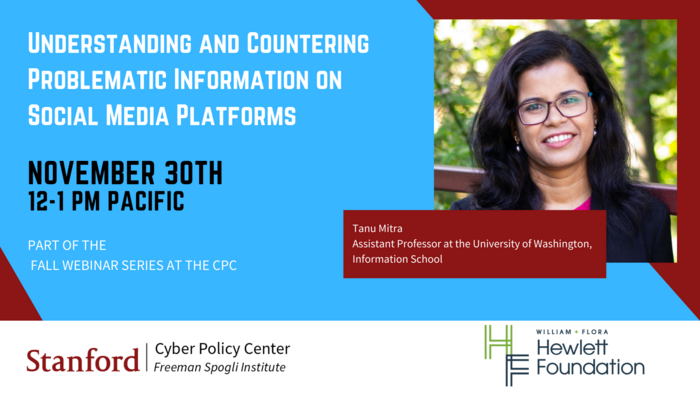
Join us Tuesday, November 30th from 12 PM - 1 PM PT for Understanding and Countering Problematic Information on Social Media Platforms featuring Tanu Mitra, Assistant Professor at University of Washington’s Information School. This seminar series is organized by the Cyber Policy Center’s Program on Democracy and the Internet and the William and Flora Hewlett Foundation’s Cyber Initiative. 

Online social media platforms have brought numerous positive changes, including access to vast amounts of news and information. Yet, those very opportunities have created new challenges—our information ecosystem is now rife with problematic content, ranging from misinformation, conspiracy theories, to hateful and incendiary propaganda. As a social computing researcher, Dr. Mitra’s work introduces computational methods and systems to understand and design defenses against such problematic online content. In this talk, she will focus on two aspects of problematic online information: 1) conspiracy theories and 2) extremist propaganda.

First, leveraging data spanning millions of conspiratorial posts on Reddit, 4chan, and 8chan, Dr. Mitra will present scalable methods to unravel who participates in online conspiratorial discussions, what causes users to join conspiratorial communities and then potentially abandon them. Second, she will dive into a special type of problematic content: extremist hate groups. Merging theories from social movement research with big data analyses, Dr. Mitra will discuss the ecosystem of extremists’ communication and the roles played by them. Finally, she will close by previewing important new opportunities to address some of these problems, including conducting social audits to defend against algorithmically generated misinformation and designing socio-technical interventions to promote meaningful credibility assessment of information.


About the speaker:

Image
Tanu Mitra
Tanu Mitra is an Assistant Professor at the University of Washington, Information School, where she leads the Social Computing research group. She and her students study and build large-scale social computing systems to understand and counter problematic information online. Her research spans auditing online systems for misinformation and conspiratorial content, understanding digital misinformation, unraveling narratives of online extremism and hate, and building technology to foster critical thinking online. Her work employs a range of interdisciplinary methods from the fields of human computer interaction, data mining, machine learning, and natural language processing. Dr. Mitra’s work has been supported by grants from the NSF, DoD, Google, Social Science One, and other Foundations. Her research has been recognized through multiple awards and honors, including an NSF-CRII, an early career ONR-YIP, Adamic-Glance Distinguished Young Researcher award and Virginia Tech College of Engineering Outstanding New Assistant Professor award, along with several best paper honorable mention awards. Dr. Mitra received her PhD in Computer Science from Georgia Tech’s School of Interactive Computing and her Masters in Computer Science from Texas A&M University

Subscribe to Security