Environment

FSI scholars approach their research on the environment from regulatory, economic and societal angles. The Center on Food Security and the Environment weighs the connection between climate change and agriculture; the impact of biofuel expansion on land and food supply; how to increase crop yields without expanding agricultural lands; and the trends in aquaculture. FSE’s research spans the globe – from the potential of smallholder irrigation to reduce hunger and improve development in sub-Saharan Africa to the devastation of drought on Iowa farms. David Lobell, a senior fellow at FSI and a recipient of a MacArthur “genius” grant, has looked at the impacts of increasing wheat and corn crops in Africa, South Asia, Mexico and the United States; and has studied the effects of extreme heat on the world’s staple crops.

-

Join the Cyber Policy Center on August 26th, at 10 a.m. pacific time, for a look how governments around the world are pushing to ban strong encryption. The talk will feature speakers Sam Woolley, Riana Pfefferkorn and Mathew Baum as they explore the different policy issues being used by governments to justify their agendas. This event is open to the public, but registration is required.

REGISTER


Matthew A. Baum (Ph.D., UC San Diego, 2000) is the Marvin Kalb Professor of Global Communications and Professor of Public Policy at Harvard University's John F. Kennedy School of Government and Department of Government. His research focuses on delineating the effects of domestic politics on international conflict and cooperation in general and American foreign policy in particular, as well as on the role of the mass media and public opinion in contemporary American politics. His research has appeared in over a dozen leading scholarly journals, such as the American Political Science ReviewAmerican Journal of Political Science, and the Journal of Politics. His books include Soft News Goes to War: Public Opinion and American Foreign Policy in the New Media Age (2003, Princeton University Press), War Stories: The Causes and Consequences of Public Views of War (2009, Princeton University Press, co-authored with Tim Groeling), and War and Democratic Constraint: How the Public Influences Foreign Policy (2015, Princeton University Press, co-authored with Phil Potter). He has also contributed op-ed articles to a variety of newspapers, magazines, and blog sites in the United States and abroad. Before coming to Harvard, Baum was an associate professor of political science and communication studies at UCLA. 

Riana Pfefferkorn is the Associate Director of Surveillance and Cybersecurity at the Stanford Center for Internet and Society. Her work focuses on investigating and analyzing the U.S. government's policy and practices for forcing decryption and/or influencing crypto-related design of online platforms and services, devices, and products, both via technical means and through the courts and legislatures. Riana also researches the benefits and detriments of strong encryption on free expression, political engagement, economic development, and other public interests.

Dr. Samuel Woolley is a writer and researcher. He is an assistant professor in the School of Journalism and in the School of Information (by courtesy) at the University of Texas at Austin.  He is the program director of propaganda research at the Center for Media Engagement at UT. Woolley's work focuses on the ways in which emerging technology are leveraged for both democracy and control. He is the author of the book "The Reality Game: How the Next Wave of Technology Will Break the Truth" (PublicAffairs), an exploration of how tools from artificial intelligence to virtual reality are being used in efforts to manipulate public opinion and discusses what society can do to respond. He is the co-editor (with Dr. Philip N. Howard), of the book "Computational Propaganda" (Oxford University Press), a series of country-based case studies on social media and digital information operations. 

-

Image
Avi Tuschman, Adam Berinsky, David Rand

Please join the Cyber Policy Center for Exploring Potential “Solutions” to Online Disinformation​, hosted by Cyber Policy Center's Kelly Born, with guests Adam Berinsky, Mitsui Professor of Political Science at MIT and Director of the MIT Political Experiments Research Lab (PERL) at MIT, David Rand, Erwin H. Schell Professor and an Associate Professor of Management Science and Brain and Cognitive Sciences, and Director of the Human Cooperation Laboratory and the Applied Cooperation Team at MIT, and Avi Tuschman, Founder & CIO, Pinpoint Predictive. The session is open but registraton is required.

Adam Berinsky is the Mitsui Professor of Political Science at MIT and serves as the director of the MIT Political Experiments Research Lab (PERL). He is also a Faculty Affiliate at the Institute for Data, Systems, and Society (IDSS). Berinsky received his PhD from the University of Michigan in 2000. He is the author of "In Time of War: Understanding American Public Opinion from World War II to Iraq" (University of Chicago Press, 2009). He is also the author of "Silent Voices: Public Opinion and Political Participation in America" (Princeton University Press, 2004) and has published articles in many journals. He is currently the co-editor of the Chicago Studies in American Politics book series at the University of Chicago Press. He is also the recipient of multiple grants from the National Science Foundation and was a fellow at the Center for Advanced Study in the Behavioral Sciences.

David Rand is the Erwin H. Schell Professor and an Associate Professor of Management Science and Brain and Cognitive Sciences at MIT Sloan, and the Director of the Human Cooperation Laboratory and the Applied Cooperation Team. Bridging the fields of behavioral economics and psychology, David’s research combines mathematical/computational models with human behavioral experiments and online/field studies to understand human behavior. His work uses a cognitive science perspective grounded in the tension between more intuitive versus deliberative modes of decision-making, and explores topics such as cooperation/prosociality, punishment/condemnation, perceived accuracy of false or misleading news stories, political preferences, and the dynamics of social media platform behavior. 

Avi Tuschman is a Stanford StartX entrepreneur and founder of Pinpoint Predictive, where he currently serves as Chief Innovation Officer and Board Director. He’s spent the past five years developing the first Psychometric AI-powered data-enrichment platform, which ranks 260 million individuals for performance marketing and risk management applications. Tuschman is an expert on the science of heritable psychometric traits. His book and research on human political orientation have been covered in peer-reviewed and mainstream media from 25 countries. Previous to his career in tech, he advised current and former heads of state as well as multilateral development banks in the Western Hemisphere. Tuschman completed his undergraduate and doctoral degrees in evolutionary anthropology at Stanford.
-

Image
towards cyber peace

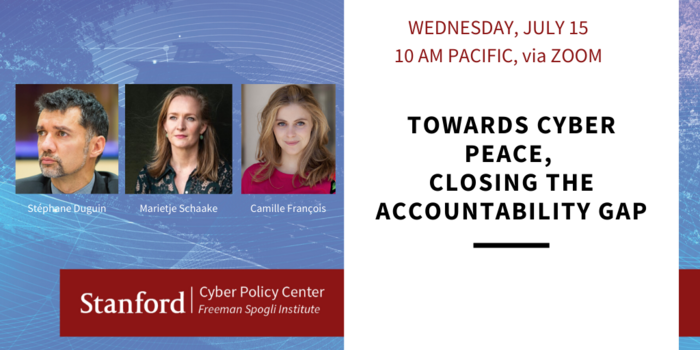
Please join the Cyber Policy Center for Towards Cyber Peace, Closing the Accountability Gap, hosted by Cyber Policy Center's Marietje Schaake, along with guests Stéphane Duguin, CEO of the Cyber Peace Institute and Camille François, CIO of Graphika and Mozilla Fellow. The discussion will focus on the challenges to cyber peace, and the work being done to chart a path forward. The session is open to the public, but registration is required. 

Marietje Schaake is the international policy director at Stanford University’s Cyber Policy Center and international policy fellow at Stanford’s Institute for Human-Centered Artificial Intelligence. She was named President of the Cyber Peace Institute. Between 2009 and 2019, Marietje served as a Member of European Parliament for the Dutch liberal democratic party where she focused on trade, foreign affairs and technology policies. Marietje is affiliated with a number of non-profits including the European Council on Foreign Relations and the Observer Research Foundation in India and writes a monthly column for the Financial Times and a bi-monthly column for the Dutch NRC newspaper. 

Camille François works on cyber conflict and digital rights online. She is the Chief Innovation Officer at Graphika, where she leads the company’s work to detect and mitigate disinformation, media manipulation and harassment. Camille was previously the Principal Researcher at Jigsaw, an innovation unit at Google that builds technology to address global security challenges and protect vulnerable users. Camille has advised governments and parliamentary committees on both sides of the Atlantic on policy issues related to cybersecurity and digital rights. She served as a special advisor to the Chief Technology Officer of France in the Prime Minister’s office, working on France’s first Open Government roadmap. Camille is a Mozilla Fellow, a Berkman-Klein Center affiliate, and a Fulbright scholar. She holds a masters degree in human rights from the French Institute of Political Sciences (Sciences-Po) and a masters degree in international security from the School of International and Public Affairs (SIPA) at Columbia University. François’ work has been featured in various publications, including the New York Times, WIRED, Washington Post, Bloomberg Businessweek, Globo and Le Monde.

Stéphane Duguin is the Chief Executive Officer of the CyberPeace Institute. His mission is to coordinate a collective response to decrease the frequency, impact, and scale of cyberattacks by sophisticated actors. Building on his hands-on experience in countering and analyzing cyber operations and information operations which impact civilians and civilian infrastructure, he leads the Institute with the aim of holding malicious actors to account for the harms they cause. Prior to this position, Stéphane Duguin was a senior manager and innovation coordinator at Europol. He led key operational projects to counter both cybercrime and online terrorism, such as the setup of the European Cybercrime Centre (EC3), the Europol Innovation Lab, and the European Internet Referral Unit (EU IRU). A leader in digital transformation, his work focused on the implementation of innovative responses to a large-scale abuse of the cyberspace, notably on the convergence of disruptive technologies and public-private partnerships.


Subscribe to Environment