Society

FSI researchers work to understand continuity and change in societies as they confront their problems and opportunities. This includes the implications of migration and human trafficking. What happens to a society when young girls exit the sex trade? How do groups moving between locations impact societies, economies, self-identity and citizenship? What are the ethnic challenges faced by an increasingly diverse European Union? From a policy perspective, scholars also work to investigate the consequences of security-related measures for society and its values.

The Europe Center reflects much of FSI’s agenda of investigating societies, serving as a forum for experts to research the cultures, religions and people of Europe. The Center sponsors several seminars and lectures, as well as visiting scholars.

Societal research also addresses issues of demography and aging, such as the social and economic challenges of providing health care for an aging population. How do older adults make decisions, and what societal tools need to be in place to ensure the resulting decisions are well-informed? FSI regularly brings in international scholars to look at these issues. They discuss how adults care for their older parents in rural China as well as the economic aspects of aging populations in China and India.

Paragraphs

VOTERS ARE BEING INUNDATED WITH POLITICAL ADVERTISING on social media and online platforms during the 2020 election season. Campaigns, PACs and third parties have added new tools and tactics for gathering data on voters and targeting them with advertising, and now they can pinpoint niches of potential voters on social media in ways unknown in prior election cycles.

Where once advertising conveyed reasons to vote for a candidate, now it frequently aims to convey misinformation, undermine trust, and depress turnout. The risk is that the spread of misinformation through such means could influence the U.S. vote, cast doubt on the democratic process and raise suspicions about the accuracy of the election outcome. 


All Publications button
1
Publication Type
Policy Briefs
Publication Date
Authors
Marietje Schaake
Authors
News Type
Q&As
Date
Paragraphs

Graham Webster leads the DigiChina Project, which translates and explains Chinese technology policy for an English-language audience so that debates and decisions regarding cyber policy are factual and based on primary sources of information.  

Housed within Stanford’s Program on Geopolitics, Technology, and Governance (GTG) and in partnership with New America, DigiChina and its community of experts have already published more than 80 translations and analyses of public policy documents, laws, regulations and political speeches and are creating an open-access knowledge base for policy-makers, academics, and members of the tech industry who need insight into the choices China makes regarding technology.

Q. Why is this work important?

A lot of tech is produced in China so it’s important to understand their policies. And in Washington, D.C., you hear a lot of people say, “Well, you can’t know what China’s doing on tech policy. It’s all a secret.” But while China’s political system is often opaque, if you happen to read Chinese, there’s a lot that’s publicly available and can explain what the Chinese government is thinking and planning.

With our network of experts, DigiChina works at the intersection of two policy challenges. One is how do we deal with high technology, and the questions around economic competitiveness, personal autonomy and the security risks that our dependence on tech creates.

The other challenge is, from a US government, business or values perspective, what needs to be done about the increased prominence and power of the Chinese government and its economic, technological and military capabilities.

These questions cut across tech sectors from IT infrastructure to data-driven automation, and cutting-edge developments in quantum technology, biotech, and other fields of research.

Q: How was DigiChina started?

A number of us were working at different organizations, think tanks, consultancies and universities and we all had an interest in explaining the laws and the bureaucratic language to others who aren’t Chinese policy specialists or don’t have the language skills.  

We started working informally at first and then reached out to New America, which is an innovative type of think tank combining research, innovation, and policy thinking on challenges arising during this time of rapid technological and social change. Under the New America umbrella, and through partnerships with the Leiden Asia Centre, a leading European research center based at the University of Leiden, and the Ethics and Governance of Artificial Intelligence Initiative at Harvard and MIT, we were able to build out the program and increase the number of experts in our network.

Q: Who is involved in DigiChina and what types of expertise do you and others bring to the project?

More than 40 people have contributed to DigiChina publications so far, and it’s a pretty diverse group. There are professors and think tank scholars, students and early-career professionals, and experienced government and industry analysts. Everyone has a different part of the picture they can contribute, and we reach out to other experts both in China and around the world when we need more context.

As for me, I was working at Yale Law School’s China Center when I was roped into what would become DigiChina and had spent several years in Beijing and New Haven working more generally on US-China relations and Track 2 dialogues, where experts and former officials from the two countries meet to take on tough problems. As a journalist and graduate student, I had long studied technology and politics in China, and I took on a coordinating role with DigiChina as I turned back to that pursuit full time.

Stanford is an ideal home because the university is a powerhouse in Chinese studies and an epicenter of global digital development.
Graham Webster
Editor in Chief, DigiChina Project

Q. Are there other organizations involved as well?

We have a strong tie to the Leiden Asia Centre at the University of Leiden in the Netherlands, where one of DigiChina’s cofounders, Rogier Creemers, is a professor, and where staff and student researchers have contributed to existing and forthcoming work. We coordinate with a number of other groups on translations, and the project benefits greatly from the time and knowledge contributed by employees of various institutions. I hope that network will increasingly be a resource for contributors and their colleagues.

The project is currently supported by the Ford Foundation, which works to strengthen democratic values, promote international cooperation and advance human achievement around the world. A generous grant from Ford will keep the lights on for two years, giving us the ability to build our open-access resource and, with further fundraising, the potential to bring on more in-house editorial and research staff.

We hope researchers and policy thinkers, regardless of their approaches or ideologies, can use our translations to engage with the real and messy evolution of Chinese tech policy.
Graham Webster
Editor in Chief, DigiChina Project

Q. Do you have plans to grow the project?

We are working to build an accessible online database so researchers and scholars can review primary source documents in both the original Chinese and in English. And we are working toward a knowledge base with background entries on key institutions, legal concepts, and phrases so that a broader audience can situate things like Chinese legal language in their actual context. Providing access to this information is especially important now and in the near future, whether we have a second Trump Administration or a Biden Administration in the United States.

On any number of policy challenges, effective measures are going to depend on going beyond caricatures like an “AI arms race,” “cyber authoritarianism,” or “decoupling,” which provide useful frameworks for debate but can tend to prejudge the outcomes of a huge number of developments. We hope researchers and policy thinkers, regardless of their approaches or ideologies, can use this work to engage with the real and messy evolution of Chinese tech policy.

Hero Image
Graham Webster Q&A
All News button
1
Subtitle

Webster explains how DigiChina makes Chinese tech policy accessible for English speakers

Paragraphs

THE EMERGENCE OF A DIGITAL SPHERE where public debate takes place raises profound questions about the connection between online information and polarization, echo chambers, and filter bubbles. Does the information ecosystem created by social media companies support the conditions necessary for a healthy democracy? Is it different from other media? These are particularly urgent questions as the United States approaches a contentious 2020 election during the COVID-19 pandemic.

The influence of technology and AI-curated information on America’s democratic process is being examined in the eight-week Stanford University course, “Technology and the 2020 Election: How Silicon Valley Technologies Affect Elections and Shape Democracy.” This issue brief focuses on the class session on “Echo Chambers, Filter Bubbles, and Polarization,” with guest experts Joan Donovan and Joshua Tucker.

All Publications button
1
Publication Type
Policy Briefs
Publication Date
Authors
Marietje Schaake
-

Image
december 10th digital tech social media and 2020 election

Since the 2016 election, great attention has been paid to the impact of digital technologies on democracy in the United States and around the world.  Foreign intervention into the U.S. campaign through social media and online advertising, including the rise of "fake news" and computational propaganda, exacerbated concerns that new technologies posed a substantial threat to the normal workings of  the U.S. electoral process.  These concerns remain for 2020, alongside new threats related to the COVID-19 pandemic.  With in-person campaigning, voter mobilization, and even voting itself hindered by the pandemic, digital technologies promise to play an even more important role in 2020.  

On December 10, 2020, the Stanford Cyber Policy Center will bring together scholars, tech platforms, principals from the digital campaigns, journalists, and other key experts to explore the effect of digital technologies on the 2020 Election.  The conference will explore the role of digital technologies on election administration, campaign tactics, political advertising, the news media, foreign propaganda efforts, and the broader campaign information ecosystem.  It will also consider how changes in platform policies affected the campaign and information environment, and whether lessons learned in the 2020 elections suggest that further changes are warranted.  

9AM:   Introduction: Kelly Born, Stanford Cyber Policy Center

9:10:    Findings from the Stanford/MIT Healthy Elections Project:  Nate Persily, Stanford Law School

9:30:    Trends in 2020 Political Advertising:  Erika Franklin Fowler, Wesleyan Media Project

9:50:    Online Political Transparency:  Laura Edelson, New York University Political Ads Project

10:10:  BREAK

10:20: Center for Technology and Civic Life’s Elections Project:  Tiana Epps-Johnson, CTCL

10:40:  Platform Speech Policies and the Elections: Daniel Kreiss and Bridget Barrett, University of North             Carolina at Chapel Hill

11:00:  Findings from the Election Integrity Project:  Alex Stamos and Renee DiResta, Stanford Internet             Observatory

11:20: BREAK

11:30:  Experiences from the Platforms

  • Nathaniel Gleicher, Head of Cybersecurity Policy at Facebook
  • Clement Wolf, Global Public Policy Lead for Information Integrity at Google
  • Yoel Roth, Director of Site Integrity at Twitter
  • Eric Han, Head of Safety at TikTok

12:30:  Full Panel Q&A/Discussion

1PM     Close

Nathaniel Persily
Erika Franklin Fowler
Daniel Kreiss
Clement Wolf
Nathaniel Gleicher
Yoel Roth
Eric Han
Bridget Barrett
Tiana Epps-Johnson
Laura Edelson
Paragraphs

THE 2020 ELECTION IN THE UNITED STATES will take place on November 3 in the midst of a global pandemic, economic downturn, social unrest, political polarization, and a sudden shift in the balance of power in the U.S Supreme Court. On top of these issues, the technological layer impacting the public debate, as well as the electoral process itself, may well determine the election outcome. The eight-week Stanford University course, “Technology and the 2020 Election: How Silicon Valley Technologies Affect Elections and Shape Democracy,” examines the influence of technology on America’s democratic process, revealing how digital technologies are shaping the public debate and the election.

The eight-week Stanford University course, “Technology and the 2020 Election: How Silicon Valley Technologies Affect Elections and Shape Democracy,” examines the influence of technology on America’s democratic process, revealing how digital technologies are shaping the public debate and the election...


All Publications button
1
Publication Type
Policy Briefs
Publication Date
Authors
Marietje Schaake
-

Image
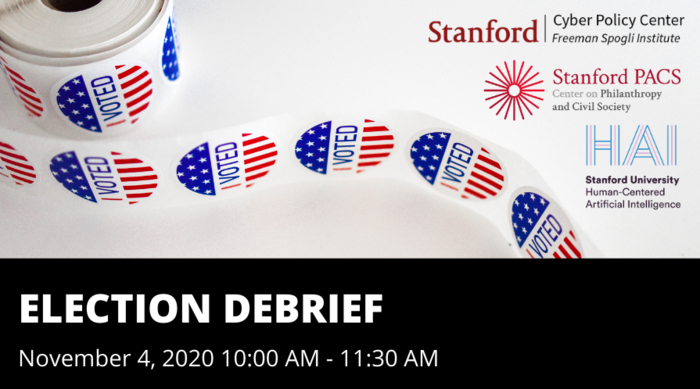
election debrief event stanford

The US 2020 elections have been fraught with challenges, including the rise of "fake news” and threats of foreign intervention emerging after 2016, ongoing concerns of racially-targeted disinformation, and new threats related to the COVID-19 pandemic. Digital technologies will have played a more important role in the 2020 elections than ever before.

On November 4th at 10am PST, join the team at the Stanford Cyber Policy Center, in collaboration with the Freeman Spogli Institute, Stanford’s Institute for Human-Centered Artificial Intelligence, and the Stanford Center on Philanthropy and Civil Society, for a day-after discussion of the role of digital technologies in the 2020 Elections.  Speakers will include Nathaniel Persily, faculty co-director of the Cyber Policy Center and Director of the Program on Democracy and the Internet, Marietje Schaake, the Center’s International Policy Director and International Policy Fellow at Stanford’s Institute for Human-Centered Artificial Intelligence, Alex Stamos, Director of the Cyber Center’s Internet Observatory and former Chief Security Officer at Facebook and Yahoo, Renee DiResta, Research Manager at the Internet Observatory, Andrew Grotto, Director of the Center’s Program on Geopolitics, Technology, and Governance, and Rob Reich, Faculty Director of the Center for Ethics in Society, in conversation with Kelly Born, the Center’s Executive Director.

Please note that we will also have a YouTube livestream available for potential overflow or for anyone having issues connecting via Zoom: https://youtu.be/H2k62-JCAgE


0
renee-diresta.jpg

Renée DiResta is the former Research Manager at the Stanford Internet Observatory. She investigates the spread of malign narratives across social networks, and assists policymakers in understanding and responding to the problem. She has advised Congress, the State Department, and other academic, civic, and business organizations, and has studied disinformation and computational propaganda in the context of pseudoscience conspiracies, terrorism, and state-sponsored information warfare.

You can see a full list of Renée's writing and speeches on her website: www.reneediresta.com or follow her @noupside.


Former Research Manager, Stanford Internet Observatory
Rob Reich
0
marietje.schaake

Marietje Schaake is a non-resident Fellow at Stanford’s Cyber Policy Center and at the Institute for Human-Centered AI. She is a columnist for the Financial Times and serves on a number of not-for-profit Boards as well as the UN's High Level Advisory Body on AI. Between 2009-2019 she served as a Member of European Parliament where she worked on trade-, foreign- and tech policy. She is the author of The Tech Coup.


Non-Resident Fellow, Cyber Policy Center
Fellow, Institute for Human-Centered Artificial Intelligence
Date Label
-

Image
October 28 event reset reclaiming the internet for civil society

Image
Reset: Reclaiming the Internet for Civil Society book cover
Digital technologies are linked to a growing number of social and political maladies, including political repression, disinformation, and polarization. Accountability for these technologies is weak, allowing authoritarian rulers and bad actors to exploit the information landscape for their gain. A largely unregulated surveillance industry, innovations in technologies of remote control, dark PR firms, and “hack-for-hire” services feeding off rivers of poorly secured personal data also muddy the waters. This set of serious, democracy-unfriendly challenges calls for a deeper reexamination of our communications ecosystem. 

On October 28th at 10am Pacific Time, join the team at the Stanford Cyber Policy Center, in collaboration with author Ronald J. DeibertEileen Donahoe, Executive Director of the Global Digital Policy Incubator at Stanford University’s Cyber Policy Center, and Larry Diamond, co-lead for the Global Digital Policy Incubator in conversation with Kelly Born, the Center’s Executive Director.


CDDRL
Stanford University
Encina Hall, C147
616 Jane Stanford Way
Stanford, CA 94305-6055

(650) 724-6448 (650) 723-1928
0
Mosbacher Senior Fellow in Global Democracy at the Freeman Spogli Institute for International Studies
William L. Clayton Senior Fellow at the Hoover Institution
Professor, by courtesy, of Political Science and Sociology
diamond_encina_hall.png MA, PhD

Larry Diamond is the William L. Clayton Senior Fellow at the Hoover Institution, the Mosbacher Senior Fellow in Global Democracy at the Freeman Spogli Institute for International Studies (FSI), and a Bass University Fellow in Undergraduate Education at Stanford University. He is also professor by courtesy of Political Science and Sociology at Stanford, where he lectures and teaches courses on democracy (including an online course on EdX). At the Hoover Institution, he co-leads the Project on Taiwan in the Indo-Pacific Region and participates in the Project on the U.S., China, and the World. At FSI, he is among the core faculty of the Center on Democracy, Development and the Rule of Law, which he directed for six and a half years. He leads FSI’s Israel Studies Program and is a member of the Program on Arab Reform and Development. He also co-leads the Global Digital Policy Incubator, based at FSI’s Cyber Policy Center. He served for 32 years as founding co-editor of the Journal of Democracy.

Diamond’s research focuses on global trends affecting freedom and democracy and on U.S. and international policies to defend and advance democracy. His book, Ill Winds: Saving Democracy from Russian Rage, Chinese Ambition, and American Complacency, analyzes the challenges confronting liberal democracy in the United States and around the world at this potential “hinge in history,” and offers an agenda for strengthening and defending democracy at home and abroad.  A paperback edition with a new preface was released by Penguin in April 2020. His other books include: In Search of Democracy (2016), The Spirit of Democracy (2008), Developing Democracy: Toward Consolidation (1999), Promoting Democracy in the 1990s (1995), and Class, Ethnicity, and Democracy in Nigeria (1989). He has edited or coedited more than fifty books, including China’s Influence and American Interests (2019, with Orville Schell), Silicon Triangle: The United States, China, Taiwan the Global Semiconductor Security (2023, with James O. Ellis Jr. and Orville Schell), and The Troubling State of India’s Democracy (2024, with Sumit Ganguly and Dinsha Mistree).

During 2002–03, Diamond served as a consultant to the US Agency for International Development (USAID) and was a contributing author of its report, Foreign Aid in the National Interest. He has advised and lectured to universities and think tanks around the world, and to the World Bank, the United Nations, the State Department, and other organizations dealing with governance and development. During the first three months of 2004, Diamond served as a senior adviser on governance to the Coalition Provisional Authority in Baghdad. His 2005 book, Squandered Victory: The American Occupation and the Bungled Effort to Bring Democracy to Iraq, was one of the first books to critically analyze America's postwar engagement in Iraq.

Among Diamond’s other edited books are Democracy in Decline?; Democratization and Authoritarianism in the Arab WorldWill China Democratize?; and Liberation Technology: Social Media and the Struggle for Democracy, all edited with Marc F. Plattner; and Politics and Culture in Contemporary Iran, with Abbas Milani. With Juan J. Linz and Seymour Martin Lipset, he edited the series, Democracy in Developing Countries, which helped to shape a new generation of comparative study of democratic development.

Download full-resolution headshot; photo credit: Rod Searcey.

Former Director of the Center on Democracy, Development and the Rule of Law
Faculty Chair, Jan Koum Israel Studies Program
Date Label
Ron Diebert
-

Image
Digital Trade Wars

Please join the Cyber Policy Center, Wednesday, October 21, from 10 a.m. –11 a.m. pacific time, with host Marietje Schaake, International Policy Director of the Cyber Policy Center, in conversation with Dmitry Grozoubinski, founder of ExplainTrade.com, and visiting professor at University of Strathclyde, along with Anu Bradford, Henry L. Moses Professor of Law and International Organizations at Columbia Law School and author of How the European Union Rules the World, for a discussion and exploration of the digital trade war. 

This event is free and open to the public, but registration is required.


0
marietje.schaake

Marietje Schaake is a non-resident Fellow at Stanford’s Cyber Policy Center and at the Institute for Human-Centered AI. She is a columnist for the Financial Times and serves on a number of not-for-profit Boards as well as the UN's High Level Advisory Body on AI. Between 2009-2019 she served as a Member of European Parliament where she worked on trade-, foreign- and tech policy. She is the author of The Tech Coup.


Non-Resident Fellow, Cyber Policy Center
Fellow, Institute for Human-Centered Artificial Intelligence
Date Label
Marietje Schaake
Anu Bradford
Dmitry Grozoubinski
Panel Discussions
-

Image
Man w/ iPad

Social media sites have now surpassed cable, network, and local TV as primary sources of political news for one-in-five Americans. Yet the speed and volume of online information, challenges discerning the credibility of online sources, and concerns about viral online disinformation place a significant burden on users. What do we know about what new user-facing digital literacy initiatives are underway, what the research has to say about the impact and effectiveness of media literacy interventions, and what the implications are for both corporate and government policy.

On Wednesday, October 14th, from 10 a.m. - 11 a.m. Pacific Time, please join Kelly Born, Executive Director of the Stanford Cyber Policy Center, in conversation with Jennifer Kavanaugh, of RAND’s Countering Truth Decay initiativeKristin Lord, President and CEO of IREX, and Claire Wardle, co-founder and director of First Draft, for a discussion on the state of Media Literacy.

Kristin Lord
Jennifer Kavanaugh
Claire Wardle
Seminars
-

Recent public outcries over facial recognition technology, police and state usage of automated surveillance tools, and racially motivated disinformation on social media have underscored the ways in which new digital technologies threaten to exacerbate existing racial and social cleavages.  What is known about how digital technologies are contributing to racial tensions, what key questions remain unanswered, and what policy changes, by government or tech platforms, might help?

On Wednesday, September 23rd, from 10 a.m. - 11 a.m. Pacific Time, please join us for Race and Technology, with Kelly Born, Executive Director of the Stanford Cyber Policy Center, in conversation with Julie Owono, the Executive Director of Internet Sans Frontières, a digital rights advocacy organization based in France, an affiliate of the Berkman Klein Center for Internet and Society at Harvard and at Stanford’s Digital Civil Society Lab, and a member of Facebook’s Oversight Board; Mutale Nkonde, CEO of AI for the People, a member of the recently formed TikTok Content Advisory Council, and a fellow at Stanford’s Digital Civil Society Lab; and Safiya Noble, Associate Professor at UCLA in the Departments of Information Studies and African American Studies, and author of Algorithms of Oppression

The event is open to the public, but registration is required.

Subscribe to Society