-

Image
header for Technology and Geopolitics: EU Proposals for Regulating Rights, Security and Trade

The future of technology policy in Europe will be affected by growing nationalism and protectionism, cyber and national security threats, and great power rivalries. The Program on Democracy and the Internet invites you to a technology policy discussion led by International Policy Director, Marietje SchaakeJoin us on September 16th from 9 AM - 12 PM PST (6 PM - 9 PM CET), as we dive into conversations on EU legislative packages, digital trade rules, and cybersecurity & geopolitics. We hope to develop a more precise understanding of how the EU and its allies can collaborate to create compatible technology standards, build more resilient supply chains, and address novel opportunities and risks presented by emerging technologies.This event is organized by the Program on Democracy and the Internet (part of the Cyber Policy Center and the Center on Philanthropy and Civil Society) and co-sponsored by the Institute for Human-Centered Artificial Intelligence.

Moderators: 


Speakers:


Seminars
News Type
News
Date
Paragraphs

POLITICO has announced their annual ranking of the 28 power players behind Europe’s tech revolution. In addition to an overall No. 1, the list is divided into three categories — rulemakers, rulebreakers and visionaries — each representing a different type of power. The Cyber Policy Center's Marietje Schaake is included on the list as a visionary and "voice to listen to on both sides of the Atlantic."

From the announcement:

The 42-year-old Dutch native has become a leading voice of European philosophy on how to regulate technology, especially in the U.S., where she’s been teaching at Stanford University’s Cyber Policy Center since leaving European politics.

Her message — that the internet’s early leaders have grown into all-too-dominant behemoths unable to subdue their own vices and are violating human rights — might have seemed out of whack in the U.S. a few years ago. But it has since become mainstream, in part thanks to Schaake’s work to reshape the American conversation on technology and inject some of Europe’s criticism on the sector.

In Europe, too, Schaake’s star keeps rising and rising. Once one of Brussels’ most visible politicians, she has now turned her attention to taming algorithms and the growing issue of cyber threats. In 2019, she launched the CyberPeace Institute in Geneva, a group focused on getting European policymakers to care about the human victims of cyberattack.

READ MORE

Marietje Schaake

Marietje Schaake

International Policy Director at the Cyber Policy Center
FULL BIO

Read More

cyber turns two graphic
News

The Cyber Policy Center Turns Two

A look back at the launch of the CPC and the work of our programs
The Cyber Policy Center Turns Two
Marietje Schaake
News

Marietje Schaake to Join Stanford Cyber Policy Center and Institute for Human-Centered Artificial Intelligence in Dual Policy Roles

Marietje Schaake to Join Stanford Cyber Policy Center and Institute for Human-Centered Artificial Intelligence in Dual Policy Roles
Hero Image
illustration of Marietje Schaake Politico
All News button
1
Subtitle

POLITICO’s annual ranking of the 28 power players behind Europe’s tech revolution includes the Cyber Policy Center's Marietje Schaake. The list is divided into three categories — rulemakers, rulebreakers and visionaries — each representing a different type of power.

Paragraphs

Whether the targets are local governmentshospital systems, or gas pipelines, ransomware attacks in which hackers lock down a computer network and demand money are a growing threat to critical infrastructure. The attack on Colonial Pipeline, a major supplier of fuel on the East Coast of the United States, is just one of the latest examples—there will likely be many more. Yet the federal government has so far failed to protect these organizations from the cyberattacks, and even its actions since May, when Colonial Pipeline was attacked, fall short of what’s necessary.

Read more 

All Publications button
1
Publication Type
Commentary
Publication Date
Subtitle
Op-ed in Bulletin of the Atomic Scientists, by Gregory Falco and Sejal Jhawer
Authors
-

Image
German Consulate logo and Stanford Logo

Technological cooperation is one of the key topics of the transatlantic agenda. The capacity of nations to innovate and to regulate will define impact their future relevancy. Beyond setting incentives to enhance innovation, Regulation and setting standards is at the forefront of the geopolitical dimension of tech policy.
 
On June 24 from 12:00 to 1:00 pm Pacific Time, Germany’s Ambassador to the United States, Dr. Emily Haber, International Policy Director at Stanford University’s Cyber Policy Center, Marietje Schaake, and Chris Riley, Senior Fellow for Internet Governance at the R Street Institute, will discuss the opportunities and challenges of the digital transformation for the US and the EU with respect to strategies to strengthen democratic public spheres, restore digital trust and promote liberal liberal-democratic values through a global digital order. Nathanial Persily, co-director of the Stanford Cyber Policy Center, will introduce and moderate the event.
 
This event is part of the series “Meeting America,” virtual talks with the German Ambassador and American stakeholders across the United States.
 
This event is co-sponsored by the German Consulate General San Francisco and the American Council on Germany.

REGISTER


About the Speakers


Dr. Emily Margarethe Haber has been German Ambassador to the United States since June 2018.   Prior to her transfer to Washington, DC, she served in various leadership functions at the Foreign Office in Berlin. In 2009, she was appointed Political Director and, in 2011, State Secretary, the first woman to hold either post. Thereafter, she was deployed to the Federal Ministry of the Interior, serving as State Secretary in charge of homeland security and migration policy from 2014 until 2018.   Emily Haber has many years of experience with Russia and the former Soviet Union. She held various posts at the German Embassy in Moscow, including Head of the Political Department. At the Foreign Office in Berlin, she served as Head of the OSCE Division and as Deputy Director-General for the Western Balkans, among other positions.   Emily Haber holds a PhD in history and is married to former diplomat Hansjörg Haber. The couple has two sons.

Chris Riley is R Street’s senior fellow of Internet Governance. He will be leading the Knight Foundation-funded project on content moderation, running convenings of a broad range of stakeholders to develop a framework for platforms managing user-generated content. Chris will also be doing policy analysis around content regulatory issues related to that project, including work on Section 230 in the United States and the Digital Services Act in the European Union.

Prior to joining R Street, Chris led global public policy work for the Mozilla Corporation, managing their work on the ground in Washington, D.C., Brussels, Delhi and Nairobi from Mozilla’s San Francisco office, and worked with government policymakers, stakeholders in industry and civil society, and internal teams at Mozilla to advance their mission. Prior to that, he worked in the U.S. Department of State to help manage the Internet Freedom grants portfolio designated by Congress to support technology development, digital safety training, research and related work as a part of advancing the expression of human rights online in internet-repressive countries.

Chris received his bachelor’s in computer science from Wheeling Jesuit University, his PhD in computer science from Johns Hopkins University and his JD from Yale Law School.

Nathaniel Persily is the James B. McClatchy Professor of Law at Stanford Law School, with appointments in the departments of Political Science, Communication, and FSI.

Marietje Schaake is the International Policy Director at Stanford University’s Cyber Policy Center and international policy fellow at Stanford’s Institute for Human-Centered Artificial Intelligence. 


0
marietje.schaake

Marietje Schaake is a non-resident Fellow at Stanford’s Cyber Policy Center and at the Institute for Human-Centered AI. She is a columnist for the Financial Times and serves on a number of not-for-profit Boards as well as the UN's High Level Advisory Body on AI. Between 2009-2019 she served as a Member of European Parliament where she worked on trade-, foreign- and tech policy. She is the author of The Tech Coup.


Non-Resident Fellow, Cyber Policy Center
Fellow, Institute for Human-Centered Artificial Intelligence
Date Label
Emily Margarethe Haber
Chris Riley
-

With the rise of national digital identity systems (Digital ID) across the world, there is a growing need to examine their impact on human rights. While these systems offer accountability and efficiency gains, they also pose risks for surveillance, exclusion, and discrimination. In several instances, national Digital ID programmes started with a specific scope of use, but have since been deployed for different applications, and in different sectors. This raises the question of how to determine appropriate and inappropriate uses of Digital ID programs, which create an inherent power imbalance between the State and its residents given the personal data they collect.

On Wednesday, June 23rd @ 10:00 am Pacific Time, join Amber Sinha of India’s Center for Internet and Society (CIS), Anri van der Spuy of Research ICT Africa (RIA) and Dr. Tom Fischer of Privacy International in conversation with Kelly Born, Director of the Hewlett Foundation’s Cyber Initiative and fellow at Stanford’s Cyber Policy Center, to discuss the challenges and opportunities posed by digital identity systems, a proposed framework for assessing trade-offs and ensuring that human rights are adequately protected, and a discussion of experiences in translating and adapting new digital ID assessment framework by CIS and RIA to different contexts and geographies.

Amber Sinha 
Anri van der Spuy
Dr. Tom Fischer 
Kelly Born
-

Image
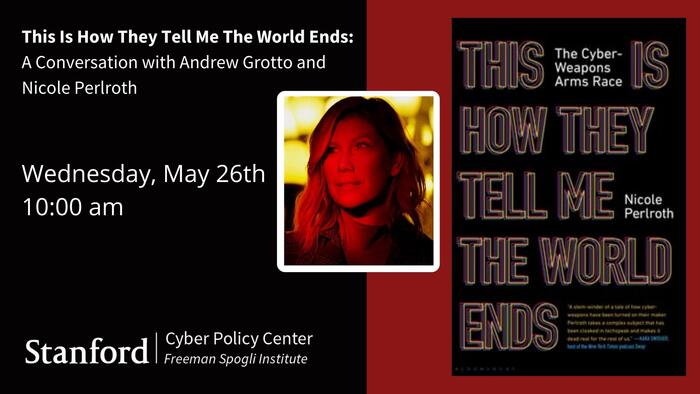
this is how they tell me the world ends event at cyber policy center

On Wednesday, May 26 at 10 am pacific time, please join Andrew Grotto, Director of Stanford’s Program on Geopolitics, Technology and Governance, for a conversation with Nicole Perlroth, New York Times Cybersecurity Reporter, about the underground market for cyber-attack capabilities.

In her book This Is How They Tell Me the World Ends: The Cyberweapons Arms Race,” Perlroth argues that the United States government became the world's dominant hoarder of one of the most coveted tools in a spy's arsenal, the zero-day vulnerability. After briefly cornering the market, in her account, the United States then lost control of its hoard and the market.

Perlroth and Grotto, a former Senior Director for Cybersecurity Policy at the White House in both the Obama and Trump Administrations, will talk about the development and evolution of this market, and what it portends about the future of conflict in cyberspace and beyond.

This event is co-sponsored by the Freeman Spogli Institute for International Studies and the Cyber Policy Center.

Praise for “This Is How They Tell Me the World Ends”: “Perlroth's terrifying revelation of how vulnerable American institutions and individuals are to clandestine cyberattacks by malicious hackers is possibly the most important book of the year . . . Perlroth's precise, lucid, and compelling presentation of mind-blowing disclosures about the underground arms race a must-read exposé.” —Booklist, starred review

Nicole Perlroth
-

What rules for the web? That question has been given new urgency on January 6th. The European Union, at the end of 2020, proposed the Digital Services Act (DSA). This new legislation aims at creating clarity about the responsibility of tech platforms and intermediaries. European rules, just as the General Data Protection Regulation (GDPR) did, will likely have ripple effects worldwide. Is there room for transatlantic alignment? How do values translate into enforceable rules? Can fundamental rights and economic growth go hand in hand? And who keep the gatekeepers in check? We will dive into the proposed Digital Services Act with leading European experts.

Join Stanford Cyber Policy Center's Marietje Schaake, International Policy Director and former Member of European Parliament in conversation with the CPC’s Daphne Keller, Director of the Center for Internet and Society, Guillermo Beltrà Navarro, European Union’s Digital Policy Lead, Eliška Pírková, Access Now’s Europe Policy Analyst and Joris van Hoboken, Professor of Law at the Vrije Universiteit Brussels.


0
top_pick_rsd25_070_0254a.jpg

Daphne Keller is the Director of Platform Regulation at the Stanford Program in Law, Science, & Technology. Her academic, policy, and popular press writing focuses on platform regulation and Internet users'; rights in the U.S., EU, and around the world. Her recent work has focused on platform transparency, data collection for artificial intelligence, interoperability models, and “must-carry” obligations. She has testified before legislatures, courts, and regulatory bodies around the world on topics ranging from the practical realities of content moderation to copyright and data protection. She was previously Associate General Counsel for Google, where she had responsibility for the company’s web search products. She is a graduate of Yale Law School, Brown University, and Head Start.

SHORT PIECES


ACADEMIC PUBLICATIONS


POLICY PUBLICATIONS


FILINGS

  • U.S. Supreme Court amicus brief on behalf of Francis Fukuyama, NetChoice v. Moody (2024)
  • U.S. Supreme Court amicus brief with ACLU, Gonzalez v. Google (2023)
  • Comment to European Commission on data access under EU Digital Services Act
  • U.S. Senate testimony on platform transparency


PUBLICATIONS LIST

Director of Platform Regulation, Stanford Program in Law, Science & Technology (LST)
Social Science Research Scholar
Date Label
0
marietje.schaake

Marietje Schaake is a non-resident Fellow at Stanford’s Cyber Policy Center and at the Institute for Human-Centered AI. She is a columnist for the Financial Times and serves on a number of not-for-profit Boards as well as the UN's High Level Advisory Body on AI. Between 2009-2019 she served as a Member of European Parliament where she worked on trade-, foreign- and tech policy. She is the author of The Tech Coup.


Non-Resident Fellow, Cyber Policy Center
Fellow, Institute for Human-Centered Artificial Intelligence
Date Label
Guillermo Beltrà Navarro
Joris van Hoboken
Eliška Pírková
Paragraphs

Appeared originally in Lawfare, November, 2020

Code is law. Lawrence Lessig’s 1999 assertion was that in a digital world, programmers were scripting a values system into their technology, often in a fit of absent-mindedness. Twenty years later, the U.S. and Europe are living in the geopolitical landscape those early pioneers created. One-time plucky startups have grown into supergiants vacuuming up ever more data and market share. Artificial intelligence (AI) is becoming both an enabler for social well-being and an instrument of authoritarian control. Emerging technologies are transforming militaries, creating new battlefields and changing the nature of warfare. U.S. and Chinese officials crisscross the world in a geostrategic great game for 5G dominance. And social media has become a vector for bad actors—including illiberal states like Russia and China—to disrupt and degrade democracies. In 2020, code is power.

The coronavirus has accelerated these trends. The pandemic has fueled data processing in contact-tracing apps; exposed vulnerabilities in supply chains; created new dependencies in classrooms and boardrooms on video communications technologies; and powered a spike in anti-vaxxer disinformation, QAnon conspiracy theories and radicalization.

All Publications button
1
Publication Type
Journal Articles
Publication Date
Authors
Marietje Schaake
Paragraphs

The internet economy has produced digital platforms of enormous economic and social significance. These platforms—specifically, Google, Facebook, Amazon, Twitter, and Apple—now play central roles in how millions of Americans obtain information, spend their money, communicate with fellow citizens, and earn their livelihoods. Their reach is also felt globally, extending to many countries around the world. They have amassed the economic, social, and political influence that very few private entities have ever obtained previously. Accordingly, they demand careful consideration from American policymakers, who should soberly assess whether the nation’s current laws and regulatory institutions are adequately equipped to protect Americans against potential abuses by platform companies.

The Program on Democracy and the Internet at Stanford University convened a working group in January 2020 to consider the scale, scope, and power exhibited by the digital platforms, study the potential harms they cause, and, if appropriate, recommend remedial policies. The group included a diverse and interdisciplinary group of scholars, some of whom had spent many years dealing with antitrust and technology issues.

All Publications button
1
Publication Type
White Papers
Publication Date
Authors
Francis Fukuyama
Marietje Schaake
Age Range
Secondary - Community College
Paragraphs

ANTITRUST AND PRIVACY CONCERNS are two of the most high-profile topics on the tech policy agenda. Checks and balances to counteract the power of companies such as Google, Amazon, and Facebook are under consideration in Congress, though a polarized political environment is a hindrance. But a domestic approach to tech policy will be insufficient, as the users of the large American tech companies are predominantly outside the United States. We need to point the way toward a transnational policy effort that puts democratic principles and basic human rights above the commercial interests of these private companies.

These issues are central to the eight-week Stanford University course, “Technology and the 2020 Election: How Silicon Valley Technologies Affect Elections and Shape Democracy.” The joint class for Stanford students and Stanford’s Continuing Studies Community enrolls a cross-generational population of more than 400 students from around the world.

All Publications button
1
Publication Type
White Papers
Publication Date
Authors
Marietje Schaake
Subscribe to Europe