Paragraphs

The first COVID-19-related death in the United States was announced on February 29, 2020, the day of the South Carolina primary. International news about the early spread of the coronavirus and the initial reaction from American public health professionals to its quick spread in this country made it clear that the presidential election was facing an existential threat. Election officials who held primaries in early- and mid-March found themselves increasingly making public health decisions to guard both their voters and their staff. The larger societal challenges quickly overwhelmed the ability of states to hold primaries at all, leading to hastily canceled and postponed elections. The one early primary that was not postponed, Wisconsin, provided cautionary tales in the form of closed polling places, poll worker shortages, and massive transitions to mail balloting.


Nate Persily

Nathaniel Persily

James B. McClatchy Professor of Law at Stanford Law School | Senior Fellow, Freeman Spogli Institute | Professor, by courtesy, Political Science | Professor, by courtesy, Communication | Co-director, Cyber Policy Center
FULL BIO
All Publications button
1
Publication Type
Working Papers
Publication Date
Subtitle
A Compendium of Research from the Stanford-MIT Healthy Elections Project
Authors
Authors
News Type
News
Date
Paragraphs

Today, the Healthy Elections Project, a joint effort of Stanford and MIT, released a new 800 page report based on their research and findings on the administration of the 2020 election. The Stanford-MIT Healthy Elections Project was developed to ensure that the 2020 election could proceed with integrity, safety, and equal access. The Project aimed to do this by bringing together academics, civic organizations, election administrators, and election administration experts to assess and promote best practices. 

The first COVID-19-related death in the United States was announced on February 29, 2020, the day of the South Carolina primary. International news about the early spread of the coronavirus and the initial reaction from American public health professionals to its quick spread in this country made it clear that the presidential election was facing an existential threat. Election officials who held primaries in early- and mid-March found themselves increasingly making public health decisions to guard both their voters and their staff. The larger societal challenges quickly overwhelmed the ability of states to hold primaries at all, leading to hastily canceled and postponed elections. The one early primary that was not postponed, Wisconsin, provided cautionary tales in the form of closed polling places, poll worker shortages, and massive transitions to mail balloting.

Nate Persily

Nathaniel Persily

James B. McClatchy Professor of Law at Stanford Law School | Senior Fellow, Freeman Spogli Institute | Professor, by courtesy, Political Science | Professor, by courtesy, Communication | Co-director, Cyber Policy Center
FULL BIO
Hero Image
virus and the vote
All News button
1
Subtitle

A Compendium of Research from the Stanford-MIT Healthy Elections Project

Paragraphs

Whether the targets are local governmentshospital systems, or gas pipelines, ransomware attacks in which hackers lock down a computer network and demand money are a growing threat to critical infrastructure. The attack on Colonial Pipeline, a major supplier of fuel on the East Coast of the United States, is just one of the latest examples—there will likely be many more. Yet the federal government has so far failed to protect these organizations from the cyberattacks, and even its actions since May, when Colonial Pipeline was attacked, fall short of what’s necessary.

Read more 

All Publications button
1
Publication Type
Commentary
Publication Date
Subtitle
Op-ed in Bulletin of the Atomic Scientists, by Gregory Falco and Sejal Jhawer
Authors
-

Image
German Consulate logo and Stanford Logo

Technological cooperation is one of the key topics of the transatlantic agenda. The capacity of nations to innovate and to regulate will define impact their future relevancy. Beyond setting incentives to enhance innovation, Regulation and setting standards is at the forefront of the geopolitical dimension of tech policy.
 
On June 24 from 12:00 to 1:00 pm Pacific Time, Germany’s Ambassador to the United States, Dr. Emily Haber, International Policy Director at Stanford University’s Cyber Policy Center, Marietje Schaake, and Chris Riley, Senior Fellow for Internet Governance at the R Street Institute, will discuss the opportunities and challenges of the digital transformation for the US and the EU with respect to strategies to strengthen democratic public spheres, restore digital trust and promote liberal liberal-democratic values through a global digital order. Nathanial Persily, co-director of the Stanford Cyber Policy Center, will introduce and moderate the event.
 
This event is part of the series “Meeting America,” virtual talks with the German Ambassador and American stakeholders across the United States.
 
This event is co-sponsored by the German Consulate General San Francisco and the American Council on Germany.

REGISTER


About the Speakers


Dr. Emily Margarethe Haber has been German Ambassador to the United States since June 2018.   Prior to her transfer to Washington, DC, she served in various leadership functions at the Foreign Office in Berlin. In 2009, she was appointed Political Director and, in 2011, State Secretary, the first woman to hold either post. Thereafter, she was deployed to the Federal Ministry of the Interior, serving as State Secretary in charge of homeland security and migration policy from 2014 until 2018.   Emily Haber has many years of experience with Russia and the former Soviet Union. She held various posts at the German Embassy in Moscow, including Head of the Political Department. At the Foreign Office in Berlin, she served as Head of the OSCE Division and as Deputy Director-General for the Western Balkans, among other positions.   Emily Haber holds a PhD in history and is married to former diplomat Hansjörg Haber. The couple has two sons.

Chris Riley is R Street’s senior fellow of Internet Governance. He will be leading the Knight Foundation-funded project on content moderation, running convenings of a broad range of stakeholders to develop a framework for platforms managing user-generated content. Chris will also be doing policy analysis around content regulatory issues related to that project, including work on Section 230 in the United States and the Digital Services Act in the European Union.

Prior to joining R Street, Chris led global public policy work for the Mozilla Corporation, managing their work on the ground in Washington, D.C., Brussels, Delhi and Nairobi from Mozilla’s San Francisco office, and worked with government policymakers, stakeholders in industry and civil society, and internal teams at Mozilla to advance their mission. Prior to that, he worked in the U.S. Department of State to help manage the Internet Freedom grants portfolio designated by Congress to support technology development, digital safety training, research and related work as a part of advancing the expression of human rights online in internet-repressive countries.

Chris received his bachelor’s in computer science from Wheeling Jesuit University, his PhD in computer science from Johns Hopkins University and his JD from Yale Law School.

Nathaniel Persily is the James B. McClatchy Professor of Law at Stanford Law School, with appointments in the departments of Political Science, Communication, and FSI.

Marietje Schaake is the International Policy Director at Stanford University’s Cyber Policy Center and international policy fellow at Stanford’s Institute for Human-Centered Artificial Intelligence. 


0
marietje.schaake

Marietje Schaake is a non-resident Fellow at Stanford’s Cyber Policy Center and at the Institute for Human-Centered AI. She is a columnist for the Financial Times and serves on a number of not-for-profit Boards as well as the UN's High Level Advisory Body on AI. Between 2009-2019 she served as a Member of European Parliament where she worked on trade-, foreign- and tech policy. She is the author of The Tech Coup.


Non-Resident Fellow, Cyber Policy Center
Fellow, Institute for Human-Centered Artificial Intelligence
Date Label
Emily Margarethe Haber
Chris Riley
-

With the rise of national digital identity systems (Digital ID) across the world, there is a growing need to examine their impact on human rights. While these systems offer accountability and efficiency gains, they also pose risks for surveillance, exclusion, and discrimination. In several instances, national Digital ID programmes started with a specific scope of use, but have since been deployed for different applications, and in different sectors. This raises the question of how to determine appropriate and inappropriate uses of Digital ID programs, which create an inherent power imbalance between the State and its residents given the personal data they collect.

On Wednesday, June 23rd @ 10:00 am Pacific Time, join Amber Sinha of India’s Center for Internet and Society (CIS), Anri van der Spuy of Research ICT Africa (RIA) and Dr. Tom Fischer of Privacy International in conversation with Kelly Born, Director of the Hewlett Foundation’s Cyber Initiative and fellow at Stanford’s Cyber Policy Center, to discuss the challenges and opportunities posed by digital identity systems, a proposed framework for assessing trade-offs and ensuring that human rights are adequately protected, and a discussion of experiences in translating and adapting new digital ID assessment framework by CIS and RIA to different contexts and geographies.

Amber Sinha 
Anri van der Spuy
Dr. Tom Fischer 
Kelly Born
0
sunny-xun-liu-headshot.jpg PhD

Sunny Xun Liu is a Senior Academic-Staff Researcher and Associate Director for Research at Stanford Social Media Lab. Liu earned her Ph.D. in Mass Communication and Media from Michigan State University. Her research focuses on the social and psychological effects of social media and AI, social media and well-being, digital literacy, how the design of social robots and AI impact psychological perceptions. Before joining Stanford, she was an Associate Professor at California State University, Stanislaus. She has won top3 faculty paper awards from ICA and AEJMC and published in communication and psychology journals. She has served on the Chinese Communication Association’s Steering Committee and the ICA and AEJMC Research Chair and a steering committee member on PRISM (Promoting Research in Social Media and Health Symposium).  Her research has been funded by NSF, Army Research Office, Google Research and Stanford HAI and has been published in multiple psychology and communication journals.

Associate Director for Research
Senior Academic-Staff Researcher
Date Label
-

Image
the trump takedown

The Facebook Oversight Board will release its decision concerning the takedown of President Donald Trump's account this Wednesday. On Thursday, May 6, from 2:00 to 3:15 PM Pacific, members of the Oversight Board will be joined by the leaders of the Stanford Cyber Policy Center to discuss the Board's decision. Two members of the Oversight Board, Michael McConnell and Julie Owono, will be joined by Nate Persily, Renee DiResta, Daphne Keller, Marietje Schaake and Alex Stamos to discuss the decision and its implications for Facebook's handling of similar controversies around the world.

Paragraphs

Image
Democracy task force paper cover

The Task Force on US Strategy to Support Democracy and Counter Authoritarianism launched in September 2020 as a joint effort of Freedom House, the Center for Strategic and International Studies (CSIS), and the McCain Institute. It has conducted itself as a working Task Force, with the active engagement of its members. The final recommendations of this report draw on the significant experience of the Task Force members, who contributed their deep expertise to help create recommendations that are both forward-looking and practical.

Eileen Donahoe of the Stanford Cyber Policy's Global Digital Policy Incubator, was a working group lead. 


All Publications button
1
Publication Type
White Papers
Publication Date
Subtitle
Report of the Task Force on US Strategy to Support Democracy and Counter Authoritarianism
Authors
-

Image
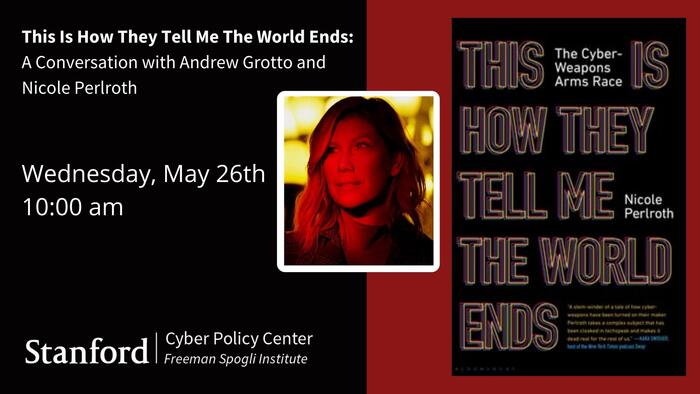
this is how they tell me the world ends event at cyber policy center

On Wednesday, May 26 at 10 am pacific time, please join Andrew Grotto, Director of Stanford’s Program on Geopolitics, Technology and Governance, for a conversation with Nicole Perlroth, New York Times Cybersecurity Reporter, about the underground market for cyber-attack capabilities.

In her book This Is How They Tell Me the World Ends: The Cyberweapons Arms Race,” Perlroth argues that the United States government became the world's dominant hoarder of one of the most coveted tools in a spy's arsenal, the zero-day vulnerability. After briefly cornering the market, in her account, the United States then lost control of its hoard and the market.

Perlroth and Grotto, a former Senior Director for Cybersecurity Policy at the White House in both the Obama and Trump Administrations, will talk about the development and evolution of this market, and what it portends about the future of conflict in cyberspace and beyond.

This event is co-sponsored by the Freeman Spogli Institute for International Studies and the Cyber Policy Center.

Praise for “This Is How They Tell Me the World Ends”: “Perlroth's terrifying revelation of how vulnerable American institutions and individuals are to clandestine cyberattacks by malicious hackers is possibly the most important book of the year . . . Perlroth's precise, lucid, and compelling presentation of mind-blowing disclosures about the underground arms race a must-read exposé.” —Booklist, starred review

Nicole Perlroth
-

Image
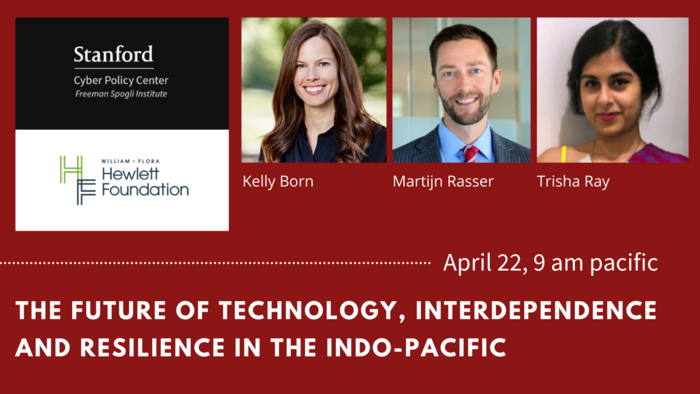
advertistement for future of tech in indo-pacific event

The Indo-Pacific will be the locus of global conflict and growth in the realm of critical and emerging technologies in the new decade. The region is home to the largest, most rapidly growing internet user bases in the world, accounting for just over half of the world’s internet users. At the same time, the US–China trade war during the Trump administration and the digital dependencies underscored by the pandemic have led some Indo-Pacific countries to rethink their own technological dependence on global supply and value chains, in favor of greater regional connectivity and resilience. There is now a sharp focus on the need for a coherent grand strategy for a “Digital Indo-Pacific”. What are the building blocks for a secure, prosperous and resilient Digital Indo-Pacific? How can the Quad, ASEAN, and other regional stakeholders cooperate to tackle broader issues relating to cybersecurity, emerging technology norms, diversifying and securing supply chains, hybrid operations and other emerging threats?

On April 22nd at 9 am PST, join Kelly Born, Director of the Cyber Initiative at the Hewlett Foundation and former Director of the Stanford Cyber Policy Center, in conversation with Trisha Ray of India’s Observer Research Foundation’s Technology and Media Initiative, and Martijn Rasser, Senior Fellow in the Technology and National Security Program at the Center for a New American Security (CNAS).

Kelly Born
Martijn Rasser
Trisha Ray
Subscribe to The Americas