Paragraphs

THE 2020 ELECTION IN THE UNITED STATES will take place on November 3 in the midst of a global pandemic, economic downturn, social unrest, political polarization, and a sudden shift in the balance of power in the U.S Supreme Court. On top of these issues, the technological layer impacting the public debate, as well as the electoral process itself, may well determine the election outcome. The eight-week Stanford University course, “Technology and the 2020 Election: How Silicon Valley Technologies Affect Elections and Shape Democracy,” examines the influence of technology on America’s democratic process, revealing how digital technologies are shaping the public debate and the election.

The eight-week Stanford University course, “Technology and the 2020 Election: How Silicon Valley Technologies Affect Elections and Shape Democracy,” examines the influence of technology on America’s democratic process, revealing how digital technologies are shaping the public debate and the election...


All Publications button
1
Publication Type
Policy Briefs
Publication Date
Authors
Marietje Schaake
-

Image
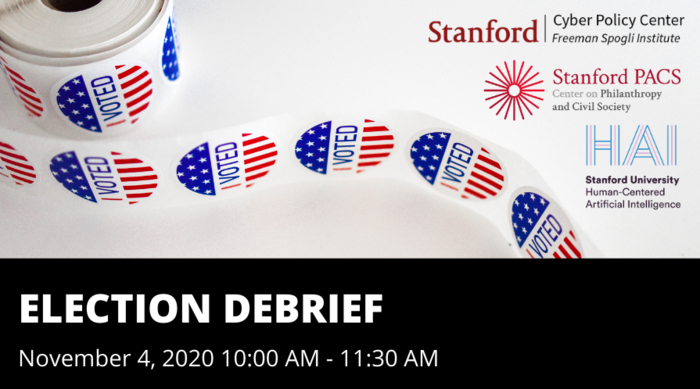
election debrief event stanford

The US 2020 elections have been fraught with challenges, including the rise of "fake news” and threats of foreign intervention emerging after 2016, ongoing concerns of racially-targeted disinformation, and new threats related to the COVID-19 pandemic. Digital technologies will have played a more important role in the 2020 elections than ever before.

On November 4th at 10am PST, join the team at the Stanford Cyber Policy Center, in collaboration with the Freeman Spogli Institute, Stanford’s Institute for Human-Centered Artificial Intelligence, and the Stanford Center on Philanthropy and Civil Society, for a day-after discussion of the role of digital technologies in the 2020 Elections.  Speakers will include Nathaniel Persily, faculty co-director of the Cyber Policy Center and Director of the Program on Democracy and the Internet, Marietje Schaake, the Center’s International Policy Director and International Policy Fellow at Stanford’s Institute for Human-Centered Artificial Intelligence, Alex Stamos, Director of the Cyber Center’s Internet Observatory and former Chief Security Officer at Facebook and Yahoo, Renee DiResta, Research Manager at the Internet Observatory, Andrew Grotto, Director of the Center’s Program on Geopolitics, Technology, and Governance, and Rob Reich, Faculty Director of the Center for Ethics in Society, in conversation with Kelly Born, the Center’s Executive Director.

Please note that we will also have a YouTube livestream available for potential overflow or for anyone having issues connecting via Zoom: https://youtu.be/H2k62-JCAgE


0
renee-diresta.jpg

Renée DiResta is the former Research Manager at the Stanford Internet Observatory. She investigates the spread of malign narratives across social networks, and assists policymakers in understanding and responding to the problem. She has advised Congress, the State Department, and other academic, civic, and business organizations, and has studied disinformation and computational propaganda in the context of pseudoscience conspiracies, terrorism, and state-sponsored information warfare.

You can see a full list of Renée's writing and speeches on her website: www.reneediresta.com or follow her @noupside.


Former Research Manager, Stanford Internet Observatory
Rob Reich
0
marietje.schaake

Marietje Schaake is a non-resident Fellow at Stanford’s Cyber Policy Center and at the Institute for Human-Centered AI. She is a columnist for the Financial Times and serves on a number of not-for-profit Boards as well as the UN's High Level Advisory Body on AI. Between 2009-2019 she served as a Member of European Parliament where she worked on trade-, foreign- and tech policy. She is the author of The Tech Coup.


Non-Resident Fellow, Cyber Policy Center
Fellow, Institute for Human-Centered Artificial Intelligence
Date Label
-

Image
October 28 event reset reclaiming the internet for civil society

Image
Reset: Reclaiming the Internet for Civil Society book cover
Digital technologies are linked to a growing number of social and political maladies, including political repression, disinformation, and polarization. Accountability for these technologies is weak, allowing authoritarian rulers and bad actors to exploit the information landscape for their gain. A largely unregulated surveillance industry, innovations in technologies of remote control, dark PR firms, and “hack-for-hire” services feeding off rivers of poorly secured personal data also muddy the waters. This set of serious, democracy-unfriendly challenges calls for a deeper reexamination of our communications ecosystem. 

On October 28th at 10am Pacific Time, join the team at the Stanford Cyber Policy Center, in collaboration with author Ronald J. DeibertEileen Donahoe, Executive Director of the Global Digital Policy Incubator at Stanford University’s Cyber Policy Center, and Larry Diamond, co-lead for the Global Digital Policy Incubator in conversation with Kelly Born, the Center’s Executive Director.


CDDRL
Stanford University
Encina Hall, C147
616 Jane Stanford Way
Stanford, CA 94305-6055

(650) 724-6448 (650) 723-1928
0
Mosbacher Senior Fellow in Global Democracy at the Freeman Spogli Institute for International Studies
William L. Clayton Senior Fellow at the Hoover Institution
Professor, by courtesy, of Political Science and Sociology
diamond_encina_hall.png MA, PhD

Larry Diamond is the William L. Clayton Senior Fellow at the Hoover Institution, the Mosbacher Senior Fellow in Global Democracy at the Freeman Spogli Institute for International Studies (FSI), and a Bass University Fellow in Undergraduate Education at Stanford University. He is also professor by courtesy of Political Science and Sociology at Stanford, where he lectures and teaches courses on democracy (including an online course on EdX). At the Hoover Institution, he co-leads the Project on Taiwan in the Indo-Pacific Region and participates in the Project on the U.S., China, and the World. At FSI, he is among the core faculty of the Center on Democracy, Development and the Rule of Law, which he directed for six and a half years. He leads FSI’s Israel Studies Program and is a member of the Program on Arab Reform and Development. He also co-leads the Global Digital Policy Incubator, based at FSI’s Cyber Policy Center. He served for 32 years as founding co-editor of the Journal of Democracy.

Diamond’s research focuses on global trends affecting freedom and democracy and on U.S. and international policies to defend and advance democracy. His book, Ill Winds: Saving Democracy from Russian Rage, Chinese Ambition, and American Complacency, analyzes the challenges confronting liberal democracy in the United States and around the world at this potential “hinge in history,” and offers an agenda for strengthening and defending democracy at home and abroad.  A paperback edition with a new preface was released by Penguin in April 2020. His other books include: In Search of Democracy (2016), The Spirit of Democracy (2008), Developing Democracy: Toward Consolidation (1999), Promoting Democracy in the 1990s (1995), and Class, Ethnicity, and Democracy in Nigeria (1989). He has edited or coedited more than fifty books, including China’s Influence and American Interests (2019, with Orville Schell), Silicon Triangle: The United States, China, Taiwan the Global Semiconductor Security (2023, with James O. Ellis Jr. and Orville Schell), and The Troubling State of India’s Democracy (2024, with Sumit Ganguly and Dinsha Mistree).

During 2002–03, Diamond served as a consultant to the US Agency for International Development (USAID) and was a contributing author of its report, Foreign Aid in the National Interest. He has advised and lectured to universities and think tanks around the world, and to the World Bank, the United Nations, the State Department, and other organizations dealing with governance and development. During the first three months of 2004, Diamond served as a senior adviser on governance to the Coalition Provisional Authority in Baghdad. His 2005 book, Squandered Victory: The American Occupation and the Bungled Effort to Bring Democracy to Iraq, was one of the first books to critically analyze America's postwar engagement in Iraq.

Among Diamond’s other edited books are Democracy in Decline?; Democratization and Authoritarianism in the Arab WorldWill China Democratize?; and Liberation Technology: Social Media and the Struggle for Democracy, all edited with Marc F. Plattner; and Politics and Culture in Contemporary Iran, with Abbas Milani. With Juan J. Linz and Seymour Martin Lipset, he edited the series, Democracy in Developing Countries, which helped to shape a new generation of comparative study of democratic development.

Download full-resolution headshot; photo credit: Rod Searcey.

Former Director of the Center on Democracy, Development and the Rule of Law
Faculty Chair, Jan Koum Israel Studies Program
Date Label
Ron Diebert
-

Image
Digital Trade Wars

Please join the Cyber Policy Center, Wednesday, October 21, from 10 a.m. –11 a.m. pacific time, with host Marietje Schaake, International Policy Director of the Cyber Policy Center, in conversation with Dmitry Grozoubinski, founder of ExplainTrade.com, and visiting professor at University of Strathclyde, along with Anu Bradford, Henry L. Moses Professor of Law and International Organizations at Columbia Law School and author of How the European Union Rules the World, for a discussion and exploration of the digital trade war. 

This event is free and open to the public, but registration is required.


0
marietje.schaake

Marietje Schaake is a non-resident Fellow at Stanford’s Cyber Policy Center and at the Institute for Human-Centered AI. She is a columnist for the Financial Times and serves on a number of not-for-profit Boards as well as the UN's High Level Advisory Body on AI. Between 2009-2019 she served as a Member of European Parliament where she worked on trade-, foreign- and tech policy. She is the author of The Tech Coup.


Non-Resident Fellow, Cyber Policy Center
Fellow, Institute for Human-Centered Artificial Intelligence
Date Label
Marietje Schaake
Anu Bradford
Dmitry Grozoubinski
Panel Discussions
-

Image
Man w/ iPad

Social media sites have now surpassed cable, network, and local TV as primary sources of political news for one-in-five Americans. Yet the speed and volume of online information, challenges discerning the credibility of online sources, and concerns about viral online disinformation place a significant burden on users. What do we know about what new user-facing digital literacy initiatives are underway, what the research has to say about the impact and effectiveness of media literacy interventions, and what the implications are for both corporate and government policy.

On Wednesday, October 14th, from 10 a.m. - 11 a.m. Pacific Time, please join Kelly Born, Executive Director of the Stanford Cyber Policy Center, in conversation with Jennifer Kavanaugh, of RAND’s Countering Truth Decay initiativeKristin Lord, President and CEO of IREX, and Claire Wardle, co-founder and director of First Draft, for a discussion on the state of Media Literacy.

Kristin Lord
Jennifer Kavanaugh
Claire Wardle
Seminars
-

Recent public outcries over facial recognition technology, police and state usage of automated surveillance tools, and racially motivated disinformation on social media have underscored the ways in which new digital technologies threaten to exacerbate existing racial and social cleavages.  What is known about how digital technologies are contributing to racial tensions, what key questions remain unanswered, and what policy changes, by government or tech platforms, might help?

On Wednesday, September 23rd, from 10 a.m. - 11 a.m. Pacific Time, please join us for Race and Technology, with Kelly Born, Executive Director of the Stanford Cyber Policy Center, in conversation with Julie Owono, the Executive Director of Internet Sans Frontières, a digital rights advocacy organization based in France, an affiliate of the Berkman Klein Center for Internet and Society at Harvard and at Stanford’s Digital Civil Society Lab, and a member of Facebook’s Oversight Board; Mutale Nkonde, CEO of AI for the People, a member of the recently formed TikTok Content Advisory Council, and a fellow at Stanford’s Digital Civil Society Lab; and Safiya Noble, Associate Professor at UCLA in the Departments of Information Studies and African American Studies, and author of Algorithms of Oppression

The event is open to the public, but registration is required.

Paragraphs

Voluntary physical distancing is essential for preventing the spread of COVID-19. We assessed the role of political partisanship in individuals’ compliance with physical distancing recommendations of political leaders using data on mobility from a sample of mobile phones in 3,100 counties in the United States during March 2020, county-level partisan preferences, information about the political affiliation of state governors, and the timing of their communications about COVID-19 prevention.

All Publications button
1
Publication Type
Journal Articles
Publication Date
Journal Publisher
PNAS Journal
Authors
Age Range
Secondary - Community College
-

Please join the Cyber Policy Center on Wednesday, September 9th, from 10 a.m. - 11 a.m. pacific time for Navigating U.S.-China Technology Futures, an online seminar, open to the public with Andrew Grotto, Director of the Program on Geopolitics, Technology, Graham Webster, editor in chief of the Stanford–New America DigiChina Project, Jeffrey Ding from the Center for International Security and Cooperation, and Jennifer Pan, Assistant Professor of Communication in the Stanford Department of Communication. Speakers will be exploring how the U.S. can address security and values challenges in U.S.-China technological cooperation, while avoiding excesses that impede innovation and harm innocent people.

This event is open to the public but registration is required.

Andrew Grotto
0
Senior Fellow at the Freeman Spogli Institute for International Studies
Professor of Communication
Professor, by courtesy, of Political Science and of Sociology
Stanford Affiliate at the Stanford Center on China's Economy and Institutions
Stanford Affiliate at the Tech Impact and Policy Center
jenniferpan-20220922-055.jpg PhD

Jennifer Pan is a Professor of Communication and a Senior Fellow at the Freeman Spogli Institute at Stanford University. Her research focuses on political communication and authoritarian politics. Pan uses experimental and computational methods with large-scale datasets on political activity in China and other authoritarian regimes to answer questions about how autocrats perpetuate their rule. How political censorship, propaganda, and information manipulation work in the digital age. How preferences and behaviors are shaped as a result.

Her book, Welfare for Autocrats: How Social Assistance in China Cares for its Rulers (Oxford, 2020) shows how China's pursuit of political order transformed the country’s main social assistance program, Dibao, for repressive purposes. Her work has appeared in peer reviewed publications such as the American Political Science Review, American Journal of Political Science, Comparative Political Studies, Journal of Politics, and Science.

She graduated from Princeton University, summa cum laude, and received her Ph.D. from Harvard University’s Department of Government.

Date Label
Jennifer Pan
Graham Webster
Jeffrey Ding
Paragraphs

Over the past two decades, U.S. and Chinese technological trajectories have been closely linked. Internet protocols, hardware design and manufacturing, software development and deployment, and services and standards have to varying degrees been crossborder phenomena, with China and the United States two of the world’s most consequential and integrated countries. The last few years, however, have seen a rise in mutual suspicion and moves—both direct and indirect—to unwind this extraordinary level of technological interdependence. The overall effect is an increasing degree of separation between the two ecosystems, a process widely known as decoupling... 


All Publications button
1
Publication Type
White Papers
Publication Date
Authors
0
Postdoctoral Fellow, Stanford Internet Observatory (2021-2022)
Predoctoral Fellow, Stanford Internet Observatory (2020-2021)
Josh-Goldstein.jpeg

Josh A. Goldstein is a past postdoctoral scholar at the Stanford Internet Observatory. He received his PhD in International Relations from the University of Oxford, where he studied as a Clarendon Scholar. At the Stanford Internet Observatory, Dr. Goldstein investigated covert influence operations on social media platforms, studied the effects of foreign interference on democratic societies, and explored how emerging technologies will impact the future of propaganda campaigns. He has given briefings to the Department of Defense, the State Department, and senior technology journalists based on this work, and published in outlets including Brookings, Lawfare, and Foreign Policy.

Prior to joining SIO, Dr. Goldstein received an MPhil in International Relations at Oxford with distinction and a BA in Government from Harvard College, summa cum laude. He also assisted with research and writing related to international security at the Belfer Center, Brookings Institution, House Foreign Affairs Committee, and Department of Defense.

Subscribe to The Americas