-

Image
Sandra González-Bailón seminar flyer

Join us  Tuesday, December 7th from 12 PM - 1 PM PST for “Media Choices, Niche Behavior, and Biases in Online Information” featuring Sandra González-Bailón, Associate Professor at the Annenberg School for Communication at University of Pennsylvania. This seminar series is organized by the Cyber Policy Center’s Program on Democracy and the Internet and the William and Flora Hewlett Foundation’s Cyber Initiative.  

The quality of our democracies relies on the quality of the information that citizens consume but we still know very little about how citizens engage with the news “in the wild”. In this talk, I will discuss two papers that examine that question in different settings. The first paper analyzes the media choices of a representative panel of the U.S. population (N ~ 55,000) as they consume TV, web, and YouTube content over a period of 44 months. Less than 10% of the panelists (N ~ 5,300) view and browse news on the three platforms. This small group of news hyper-consumers is formed predominantly by older male users with higher education. We find no evidence of substitution effects in the time these users spend consuming news on each of the three platforms, but consuming news across the media landscape is a choice that only a small and unrepresentative slice of the population makes. These results help us characterize the digital equivalent of the ‘opinion leaders’ first proposed to understand the effects of mass media. The hyper-consumers we identify in our analyses create the elite of opinion leaders that have a disproportionate influence in how news content is selected, circulated, and (ultimately) algorithmically amplified. That this small group is far from representing the population at large is one of the ways in which online information may perpetuate important biases in the salience of some topics over others. The second paper analyzes news sharing in social media during one of the largest protest mobilizations in U.S. history to examine ideological asymmetries in the posting of news content. We extract the list of URLs shared during the mobilization period and we characterize those web sites in terms of their audience reach and the ideological composition of that audience. We also analyze the reliability of the sites in terms of the credibility and transparency of the information they publish. We show that there is no evidence of unreliable sources having any prominent visibility during the protest period, but we do identify asymmetries in the ideological slant of the sources shared, with a clear bias towards right-leaning domains. Our results suggest that online networks are contested spaces where the activism of progressive movements coexists with the narratives of mainstream media, which gain visibility under the same stream of information but whose reporting is not necessarily aligned with the activists’ goals.

About the speaker:

Sandra González-Bailón is an Associate Professor at the Annenberg School for Communication, and affiliated faculty at the Warren Center for Network and Data Sciences. Her research lies at the intersection of network science, computational tools, and political communication. She is the author of Decoding the Social World (MIT Press, 2017) and co-editor of The Oxford Handbook of Networked Communication (OUP, 2020). More information on her research can be found at https://sandragonzalezbailon.net/
 
Her articles have appeared in journals like PNAS, Nature, Science, Political Communication, The Journal of Communication, and Social Networks, among others. She is the author of the book Decoding the Social World (MIT Press, 2017) and co-editor of The Oxford Handbook of Networked Communication (OUP, 2020). She serves as Associate Editor for the journals Social Networks, EPJ Data Science, and The International Journal of Press/Politics, and she is a member of the Board of Reviewing Editors for Science. She leads the research group DiMeNet (/daɪmnet/) — acronym for Digital Media, Networks, and Political Communication.


Seminars
-

Image
Deen Freelon photo along with flyer for event

Join us on November 16th for “Analyzing Social Media From A User-eye View With PIEGraph” from 12 - 1 PM PT featuring Deen Freelon, associate professor at the UNC Hussman School of Journalism and Media at the University of North Carolina. This session will be moderated by Jeff Hancock, founding director of the Stanford Social Media Lab and is organized by the Cyber Policy Center’s Program on Democracy and the Internet and the William and Flora Hewlett Foundation’s Cyber Initiative. 

Quantitative social media research has traditionally been conducted from what might be called a platform-centric view, wherein researchers sample, collect, and analyzed data based on one or more topic- or user-specific keywords. Such studies have yielded many valuable insights, but they convey little about individual users’ tailored social media environments—what Professor Freelon calls the user-eye view. Studies that investigate social media from a user-eye view tend to be rare because of the expense involved and a limited number of suitable tools. This talk introduces PIEGraph, a novel system for user-eye view research that offers key advantages over existing systems. PIEGraph is lightweight, scalable, open-source, OS-independent, and collects data viewable from mobile and desktop interfaces directly from APIs. The system incorporates an extensible tagging taxonomy that allows for straightforward classification of a wide range of political, social, and cultural phenomena. The presentation will focus on how Professor Freelon’s research team is using PIEGraph to examine users’ potential levels of exposure to high- and low-quality information sources across the ideological spectrum.

Speakers:

Deen Freelon is an associate professor at the UNC Hussman School of Journalism and Media at the University of North Carolina and a principal researcher at the Center for Information, Technology, and Public Life (CITAP). His theoretical interests address how ordinary citizens use social media and other digital communication technologies for political purposes, paying particular attention to how identity characteristics (e.g. race, gender, ideology) influence these uses. Methodologically, he is interested in how computational research techniques can be used to answer some of the most fundamental questions of communication science. Freelon has worked at the forefront of political communication and computational social science for over a decade, coauthoring some of the first communication studies to apply computational methods to social media data. 

Jeff Hancock is the founding director of the Stanford Social Media Lab and is Harry and Norman Chandler Professor of Communication at Stanford University. Professor Hancock and his group work on understanding psychological and interpersonal processes in social media. The team specializes in using computational linguistics and experiments to understand how the words we use can reveal psychological and social dynamics, such as deception and trust, emotional dynamics, intimacy and relationships, and social support. Recently Professor Hancock has begun work on understanding the mental models people have about algorithms in social media, as well as working on the ethical issues associated with computational social science.

0
top_pick_rsd25_070_0472a.jpg PhD

Jeff Hancock is founding director of the Center and well-known for his research on how people use deception with technology, from sending texts and emails to detecting fake online reviews.  He is the Harry and Norman Chandler Professor of Communication at Stanford University, Founding Director of the Stanford Social Media Lab, a senior fellow at the Freeman Spogli Institute (FSI), Founding Editor of the Journal of Online Trust & Safety, and previously the co-director of the Stanford Cyber Policy Center.

A leading expert in behavioral sciences and the psychology of online interaction, Professor Hancock studies the psychological aspects of social media and AI technology. Professor Hancock earned his PhD in Psychology at Dalhousie University, Canada and was Professor of Information Science and Communication at Cornell prior to joining Stanford in 2015.  

Director, Stanford Social Media Lab
Director, Stanford Tech Impact and Policy Center
Senior Fellow at the Freeman Spogli Institute for International Studies
Institute Faculty, Freeman Spogli Institute for International Studies
Date Label
Deen Freelon
Seminars
-


Image
David Kaye event, the global spyware crisis and how to stop it

Join us November 2nd from 12 PM - 1 PM PT for “The Global Spyware Crisis and How to Stop It” featuring David Kaye, professor of law at University of California, Irvine, and moderated by Kelly Born, director of the Cyber Initiative at the William and Flora Hewlett Foundation. This seminar series is organized by the Cyber Policy Center’s Program on Democracy and the Internet and the Hewlett Foundation’s Cyber Initiative. 

The private surveillance (or spyware) industry has thrived with low levels of transparency and public scrutiny and weak controls on transfers of technology. Governments offer limited information on the use of surveillance products and regulations of private surveillance companies. Meanwhile, these tools – most famously but not exclusively the Pegasus malware of the Israeli NSO Group – are increasingly used against journalists, opposition figures, those in dissent, and others. Public reporting – particularly energized by release of the Pegasus Project reporting by the Forbidden Stories consortium in the summer of 2021 – has begun to generate increasing global concern, and yet policy and law lag far behind. This presentation will focus on a human rights-based legal and policy framework for the regulation and accountability of, as well as transparency within, the private surveillance industry.

Speaker Profile:

David Kaye is a professor of law at the University of California, Irvine, director of its International Justice Clinic, and co-director of the Center on Fair Elections and Free Speech. From 2014 – 2020 he served as the United Nations Special Rapporteur on the promotion and protection of the right to freedom of opinion and expression. Author of Speech Police: The Global Struggle to Govern the Internet (2019), he is currently Independent Chair of the Board of the Global Network Initiative and a Trustee of ARTICLE 19.


David Kaye Professor of Law, UC Irvine
-

Image
jacob helberg the wires of war event flyer showing his photo and book cover

Image
the wires of war book cover showing a dragon and an eagle fighting over a rope
On Wednesday, October 27 at 10 am Pacific Time, please join Andrew Grotto, Director of Stanford’s Program on Geopolitics, Technology and Governance, for a conversation with Jacob Helberg, senior adviser at the Stanford Program on Geopolitics, Technology and Governance and an adjunct fellow at the Center for Strategic and International Studies (CSIS) to discuss his newly released book "The Wires of War:  Technology and the Global Struggle for Power" - an urgent and groundbreaking account of the high-stakes global cyberwar brewing between Western democracies and the autocracies of China and Russia that could potentially crush democracy.

From 2016 to 2020, Jacob Helberg led Google’s global internal product policy efforts to combat disinformation and foreign interference. During this time, he found himself in the midst of what can only be described as a quickly escalating two-front technology cold war between democracy and autocracy.

On the front-end, we’re fighting to control the software—applications, news information, social media platforms, and more—of what we see on the screens of our computers, tablets, and phones, a clash which started out primarily with Russia but now increasingly includes China and Iran. Even more ominously, we’re also engaged in a hidden back-end battle—largely with China—to control the Internet’s hardware, which includes devices like cellular phones, satellites, fiber-optic cables, and 5G networks.

This tech-fueled war will shape the world’s balance of power for the coming century as autocracies exploit twenty-first-century methods to re-divide the world into twentieth century-style spheres of influence. Helberg cautions that the spoils of this fight are power over every meaningful aspect of our lives, including our economy, our infrastructure, our national security, and ultimately, our national sovereignty. Without a firm partnership with the government, Silicon Valley is unable to protect democracy from the autocrats looking to sabotage it from Beijing to Moscow and Tehran. The stakes of the ongoing cyberwar are no less than our nation’s capacity to chart its own future, the freedom of our democratic allies, and even the ability of each of us to control our own fates, Helberg says. And time is quickly running out.


Praise for “The Wires of War: Technology and the Global Struggle for Power”: 

“An analytical tour de force on the rapidly increasing challenge of techno-authoritarian nations to our national security, our economy, and our democracy.” —President Bill Clinton, 42nd President of the United States


REGISTER

-

Image
jawboning as a first amendment problem

PART OF THE FALL SEMINAR SERIES

Join us on October 19th for our weekly seminar from 12 PM - 1 PM PT featuring Genevieve Lakier, Professor of Law at University of Chicago's Law School and CPC Co-Director, Nate Persily. This series is organized by the Program on Democracy and the Internet, and the Cyber Initiative at the William and Flora Hewlett Foundation.

For years now, scholars have expressed alarm at the tendency of government officials to pressure—or “jawbone”—social media companies into taking down what the officials consider to be harmful or offensive speech, even when no law requires it. Scholars have worried, for good reason, that the practice of jawboning allows government officials to evade the stringent constraints on their power to regulate speech imposed by the First Amendment. But relatively little attention has been paid to the constitutional question of whether, or rather when, government jawboning itself violates the First Amendment. In fact, answering this question turns out to be quite difficult because of deep inconsistencies in the cases that deal with jawboning, both in the social media context and beyond. In this talk, I will explore what those inconsistencies are, why the case law is so unclear about where the line between permissible government pressure and unconstitutional governmental coercion falls, and what kind of jawboning rule might be necessary to protect free speech values in a public sphere in which both private companies and government officials possess considerable power to determine who can and cannot speak.


REGISTER


Speaker Profile:

Genevieve Lakier teaches and writes about freedom of speech and American constitutional law. Her work examines the changing meaning of freedom of speech in the United States, the role that legislatures play in safeguarding free speech values, and the fight over freedom of speech on the social media platforms.
 
Genevieve has an AB from Princeton University, a JD from New York University School of Law, and an MA and PhD in anthropology from the University of Chicago. Between 2006 and 2008, she was an Academy Scholar at the Weatherhead Center for International and Area Studies at Harvard University. After law school, she clerked for Judge Leonard B. Sand of the Southern District of New York and Judge Martha C. Daughtrey of the Sixth Circuit Court of Appeals. Before joining the faculty, Genevieve taught at the Law School as a Bigelow Fellow and Lecturer in Law. She will serve as the Senior Visiting Research Scholar at the Knight Institute at Columbia University for the 2021-2022 school year, where she will be supervising a project exploring the relationship between the First Amendment and the regulation of lies, disinformation and misinformation.


Genevieve Lakier,
Seminars
Authors
News Type
Commentary
Date
Paragraphs

The disclosures made by whistleblower Frances Haugen about Facebook — first to the Wall Street Journal and then to “60 Minutes” — ought to be the stuff of shareholders’ nightmares: When she left Facebook, she took with her documents showing, for example, that Facebook knew Instagram was making girls’ body-image issues worse, that internal investigators knew a Mexican drug cartel was using the platform to recruit hit men and that the company misled its own oversight board about having a separate content appeals process for a large number of influential users. (Haugen is scheduled to appear before a Congressional panel on Tuesday.)

Facebook, however, may be too big for the revelations to hurt its market position — a sign that it may be long past time for the government to step in and regulate the social media company. But in order for policymakers to effectively regulate Facebook — as well as Google, Twitter, TikTok and other Internet companies — they need to understand what is actually happening on the platforms.


Nate Persily

Nathaniel Persily

Co-director, Cyber Policy Center
FULL BIO
Hero Image
Frances Haugen 60 minutes interview
Former Facebook product manager Frances Haugen appears on “60 Minutes.” Haugen has been revealed as the source behind tens of thousands of pages of leaked internal company research. (Robert Fortunato for CBSNews/“60 Minutes") (Photo by Robert Fortunato/CBSNews/60MINUTES)
All News button
1
Subtitle

The social media company shouldn’t be able to hide information about whether and how it harms users (from the Washington Post)

-

Image
Soojong Kim event flyer for October 12th showing his face and name of event

PART OF THE FALL SEMINAR SERIES

Join us at the weekly Cyber Policy Center (CPC) seminar on Tue, October 12th from 12 PM - 1 PM PST featuring Soojong Kim, postdoctoral fellow at the Program on Democracy and the Internet. This session will be moderated by Co-Director of the CPC, Nate Persily. This is part of the fall seminar series organized by the Program on Democracy and the Internet, and the William and Flora Hewlett Foundation’s Cyber Initiative.

There has been growing concern about online misinformation and falsehood. It has been suspected that the proliferation of misleading narratives is especially severe on Facebook, the world’s largest social media site, but there has been a lack of large-scale systematic investigations on these issues. This talk will introduce a series of ongoing research projects investigating online groups promoting misleading narratives on Facebook, including anti-vaccine groups, climate change denialists, countermovements against racial justice movements, and conspiracy theorists. The presentation will discuss the prevalence, characteristics, ecosystem of misleading narratives on Facebook, and implications for potential interventions.


REGISTER


Speaker Profile:

Soojong Kim is a postdoctoral fellow, jointly affiliated with the Program on Democracy and the Internet (PDI) and the Digital Civil Society Lab (DCSL) at Stanford University. He received his Ph.D. at the Annenberg School for Communication, University of Pennsylvania. His research centers around digital media, social networks, and information propagation. As a former computer scientist, he is also interested in developing and applying computational methods, including online experiments, large-scale data analysis, and computational modeling.


Seminars
-

Image
out of the rabbit hole event flyer with photo of becca lewis

PART OF THE FALL SEMINAR SERIES

Join us on October 5th at the Cyber Policy Center seminar from 12 PM - 1 PM PST featuring Becca Lewis, PhD Candidate in Communication at Stanford University. The session will be moderated by Kelly Born, Director of the Cyber Initiative at the William and Flora Hewlett Foundation. 

Conventional wisdom suggests that conspiracy theories and far-right propaganda thrive mainly at the end of algorithmic rabbit holes, in the deep, dark corners of the internet. This presentation will show that the opposite is true by explaining how in fact, harmful ideas gain traction through the charisma and popularity of internet celebrities in mainstream social media contexts. Through her extensive research on far-right YouTubers, Becca Lewis argues that instead of merely focusing our responses on the threat of algorithmic rabbit holes, we must also understand the power of amplification through thriving alternative media systems on- and offline.


REGISTER


Speaker Profile:

Becca Lewis is a Stanford Graduate Fellow and PhD candidate in Communication at Stanford University, as well as a research affiliate at Data & Society Research Institute and the University of North Carolina’s Center for Information, Technology, and Public Life. Her research has been published in the journals Society Media + Society, Television and New Media, and American Behavioral Scientist, and her public writing has appeared in outlets including The Guardian, New York Magazine, and Columbia Journalism Review. She holds an MSc in Social Science from the Oxford Internet Institute.


Becca Lewis Stanford Graduate Fellow and PhD candidate in Communication at Stanford University
Seminars
-

Image
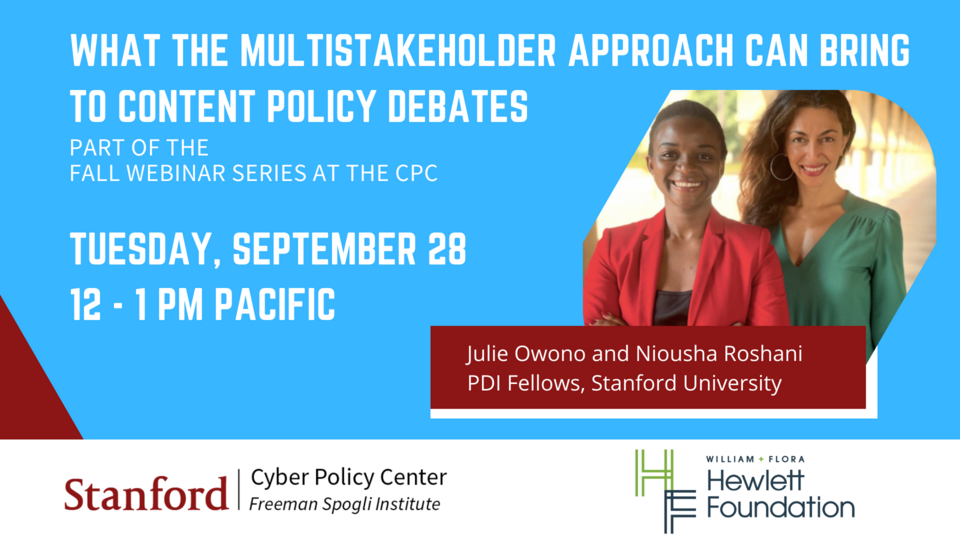
Julie Owono & Dr. Niousha Roshani Event September 28

PART OF THE FALL SEMINAR SERIES

Join us via Zoom on Tue, September 28th from 12 PM - 1 PM PST for a conversation with PDI fellows, Julie Owono and Dr Niousha Roshani, moderated by Co-Director of the Cyber Policy Center, Nathaniel Persily, as they discuss the challenges to content policy and the solutions that a multistakeholder approach has to offer. This is part of the fall seminar series organized by Stanford Cyber Policy Center’s Program on Democracy and the Internet, and the William and Flora Hewlett Foundation’s Cyber Initiative. 


REGISTER


The multistakeholder governance model is increasingly presented as a solution for addressing content governance issues online. While this inclusive and collaborative approach mirrors the foundational principle of an “open and free internet”, challenges with online content around scale and rapidity notably, call for further experimentation. 

The Content Policy & Society Lab (CPSL), a new project of the Program on Democracy and the Internet (PDI) at Stanford’s Cyber Policy Center (CPC), aims to be one of these experiments - by creating a safe space for a diverse array of stakeholders from government, the private sector, civil society, and academia to share knowledge and collaborate on solutions.

Moderator: Nathaniel Persily, Co-Director, Cyber Policy Center

Speakers: Julie Owono, PDI Fellow and Niousha Roshani, PDI Fellow


Julie Owono
Niousha Roshani
Seminars
-

Image
header for Technology and Geopolitics: EU Proposals for Regulating Rights, Security and Trade

The future of technology policy in Europe will be affected by growing nationalism and protectionism, cyber and national security threats, and great power rivalries. The Program on Democracy and the Internet invites you to a technology policy discussion led by International Policy Director, Marietje SchaakeJoin us on September 16th from 9 AM - 12 PM PST (6 PM - 9 PM CET), as we dive into conversations on EU legislative packages, digital trade rules, and cybersecurity & geopolitics. We hope to develop a more precise understanding of how the EU and its allies can collaborate to create compatible technology standards, build more resilient supply chains, and address novel opportunities and risks presented by emerging technologies.This event is organized by the Program on Democracy and the Internet (part of the Cyber Policy Center and the Center on Philanthropy and Civil Society) and co-sponsored by the Institute for Human-Centered Artificial Intelligence.

Moderators: 


Speakers:


Seminars
Subscribe to Russia and Eurasia