International Relations

FSI researchers strive to understand how countries relate to one another, and what policies are needed to achieve global stability and prosperity. International relations experts focus on the challenging U.S.-Russian relationship, the alliance between the U.S. and Japan and the limitations of America’s counterinsurgency strategy in Afghanistan.

Foreign aid is also examined by scholars trying to understand whether money earmarked for health improvements reaches those who need it most. And FSI’s Walter H. Shorenstein Asia-Pacific Research Center has published on the need for strong South Korean leadership in dealing with its northern neighbor.

FSI researchers also look at the citizens who drive international relations, studying the effects of migration and how borders shape people’s lives. Meanwhile FSI students are very much involved in this area, working with the United Nations in Ethiopia to rethink refugee communities.

Trade is also a key component of international relations, with FSI approaching the topic from a slew of angles and states. The economy of trade is rife for study, with an APARC event on the implications of more open trade policies in Japan, and FSI researchers making sense of who would benefit from a free trade zone between the European Union and the United States.

-

Abstract:

Considerable scholarship has established that algorithms are an increasingly important part of what information people encounter in everyday life. Much less work has focused on studying users’ experiences with, understandings of, and attitudes about how algorithms may influence what they see and do. The dearth of research on this topic may be in part due to the difficulty in studying a subject about which there is no known ground truth given that details about algorithms are proprietary and rarely made public. In this talk, I will report on the methodological challenges of studying people’s algorithm skills based on 83 in-person interviews conducted in five countries. I will also discuss the types of algorithm skills identified from our data. The talk will advocate for more such scholarship to accompany existing system-level analyses of algorithms’ social implications and offers a blue print for how to do this.

Image
Eszter Hargittai
About the Speaker:

Eszter Hargittai is Professor and Chair of Internet Use and Society at the Institute of Communication and Media Research, University of Zurich. Previously, she was the Delaney Family Professor in the Communication Studies Department at Northwestern University. In 2019, she was elected Fellow of the International Communication Association and also received the William F. Ogburn Mid-Career Achievement Award from the American Sociological Association’s section on Communication, Information Technology and Media Sociology. For over two decades, she has been researching people’s Internet uses and skills, and how these relate to questions of social inequality.


Paragraphs

Protecting Electoral Integrity in the Digital Age | The Report of the Kofi Annan Commission on Elections and Democracy in the Digital Age

New information and communication technologies (ICTs) pose difficult challenges for electoral integrity. In recent years foreign governments have used social media and the Internet to interfere in elections around the globe. Disinformation has been weaponized to discredit democratic institutions, sow societal distrust, and attack political candidates. Social media has proved a useful tool for extremist groups to send messages of hate and to incite violence. Democratic governments strain to respond to a revolution in political advertising brought about by ICTs. Electoral integrity has been at risk from attacks on the electoral process, and on the quality of democratic deliberation.

The relationship between the Internet, social media, elections, and democracy is complex, systemic, and unfolding. Our ability to assess some of the most important claims about social media is constrained by the unwillingness of the major platforms to share data with researchers. Nonetheless, we are confident about several important findings.

All Publications button
1
Publication Type
Annual Reports
Publication Date
Authors
Alex Stamos
-

On January 11, 2020 Taiwan held its presidential and legislative elections. Many observers expected the People’s Republic of China (PRC) to run an online disinformation campaign during the lead-up to the election in support of their preferred candidate, Han Kuo-yu, who was challenging incumbent Tsai Ing-wen. Such concerns were increased by demonstrated PRC online disinformation targeting the Hong Kong protests, and claims by an alleged PRC spy saying he led disinformation efforts targeting Taiwan during the 2018 elections. 

In this talk, we delve into case studies that highlight the role social media plays in disinformation at large in the Taiwanese information environment. We examine that while the fears of disinformation were generally not realized, we did find evidence of coordinated inauthentic behavior on Facebook, in particular on fan Pages and Groups for the two candidates. Our findings hold implications for researchers trying to distinguish authentic hyper-partisan domestic activism from coordinated disinformation. 

Image
Carly Miller

Carly Miller is a social science researcher at the Stanford Internet Observatory. In addition to covering the Taiwanese election, she assists the team in other digital forensic research and thinking about how researchers external to social media platforms think about disinformation campaign and concepts such as attribution. Before coming to Stanford, Carly was a Team Lead at the Human Rights Investigations Lab at Berkeley Law School where she worked to unearth patterns of various bad actors’ media campaigns. Carly received her BA with honors in political science from the University of California, Berkeley in May 2019.


Image
Vanessa Molter


Vanessa Molter is a Research Assistant at SIO and a Master in International Policy candidate at Stanford University, where she focuses on International Security in East Asia. At SIO, she monitors and writes on the Taiwanese social media environment. Previously, she has studied Taiwanese security affairs at the Institute for National Defense and Security Research in Taipei, Taiwan, a government-affiliated defense think-tank. Vanessa is fluent in Mandarin and holds a B.S. in International Business and East Asian studies from Tubingen University, Germany.

 

-

Abstract: A Supply and Demand Framework for YouTube Politics (with Joseph Phillips)

Youtube is the most used social network in the United States. However, for a combination of sociological and technical reasons, there exist little quantitative social science research on the political content on Youtube, in spite of widespread concern about the growth of extremist YouTube content. An emerging journalistic consensus theorizes the central role played by the video "recommendation engine," but we believe that this is premature. Instead, we propose the "Supply and Demand" framework for analyzing politics on YouTube. We discuss a number of novel technological affordances of YouTube as a platform and as a collection of videos, and how each might drive supply of or demand for extreme content. We then provide large-scale longitudinal descriptive information about the supply of and demand for alternative political content on YouTube. We demonstrate that viewership of far-right videos peaked in 2017.

Image
Kevin Munger
Kevin Munger is Assistant Professor of Political Science and Social Data Analytics, Penn State University. Ph.D., New York University, 2018. His research looks at social media and other contemporary internet technology has changed political communication. He has published research on the subject using a variety of methodologies, including textual analysis, field experiments, longitudinal surveys and qualitative theory. His research has appeared in leading journals like the American Journal of Political Science, Political Behavior, Political Communication, and Political Science Research & Methods. His present interests include cohort conflict in American politics and developing new methods for social science in a rapidly changing world.

-

renee diresta Renne DiResta
Abstract: Disinformation campaigns and black propaganda are not new, but they are evolving. Media coverage of disinformation and propaganda has focused primarily on the social-first memetic operations of the Internet Research Agency and its targeting of the United States 2016 presidential election. This talk examines a broader collection of influence operations, all affiliated with one state adversary – Russia – but leveraging distinctly different tactics. It investigates a 'playbook' that is far more expansive (and evolving) than previously understood, and assesses disinformation campaigns along several axes. We explore narrative vs memetic pathways, long-term vs discrete actions, and a collection of goals ranging from persuasion to distraction. This talk also discusses how online influence operations are deployed in conjunction hack-and-leak campaigns, and community infiltration. 

Renee DiResta Bio >


E207, Encina Hall 

0
renee-diresta.jpg

Renée DiResta is the former Research Manager at the Stanford Internet Observatory. She investigates the spread of malign narratives across social networks, and assists policymakers in understanding and responding to the problem. She has advised Congress, the State Department, and other academic, civic, and business organizations, and has studied disinformation and computational propaganda in the context of pseudoscience conspiracies, terrorism, and state-sponsored information warfare.

You can see a full list of Renée's writing and speeches on her website: www.reneediresta.com or follow her @noupside.


Former Research Manager, Stanford Internet Observatory
Renee DiResta Research Manager Stanford Internet Observatory
Seminars
-

Image
Ashish Goel
Abstract:

While the Internet has revolutionized many aspects of our lives, there are still no online alternatives for making democratic decisions at large scale as a society. In this talk, we will describe algorithmic and market-inspired approaches towards large scale decision making that our research group is exploring. We will start with a model of opinion dynamics that can potentially lead to polarization, and relate that to commonly used recommendation algorithms. We will then describe the algorithms behind Stanford's participatory budgeting platform, and the lessons that we learnt from deploying this platform in over 70 civic elections. We will use this to motivate the need for a modern theory of social choice that goes beyond voting on candidates. We will then describe ongoing practical work on an automated moderator bot for civic deliberation (in collaboration with Jim Fishkin's group), and ongoing theoretical work on deliberative approaches to decision making. We will conclude with a summary of open directions, focusing in particular on fair advertising. 

Ashish Goel Bio

Lunch Seminar Series Flyer
  • E207, Encina Hall
  • 616 Jane Stanford Way, Stanford, CA 94305
 
Ashish Goel Professor of Management Science and Engineering
Seminars
Paragraphs

The Program on Democracy and the Internet runs the work of the Kofi Annan Commission on Elections and Democracy in the Digital Age which will produce guidelines to support democracies, particularly those of the global south. 

In the span of just two years, the widely shared utopian vision of the internet’s impact on governance has turned decidedly pessimistic.  The original promise of digital technologies was unapologetically democratic: empowering the voiceless, breaking down borders to build cross-national communities, and eliminating elite referees who restricted political discourse. 

That promise has been undercut by concern that the most democratic features of the internet are, in fact, endangering democracy itself.  Democracies pay a price for internet freedom, under this view, in the form of disinformation, hate speech, incitement, and foreign interference in elections.  They also become captive to the economic power of certain platforms, with all the accompanying challenges to privacy and speech regulation that these new, powerful information monopolies have posed.

As it forges ahead in its mandate, the Kofi Annan Commission on Elections and Democracy in the Digital Age must consider these many challenges, as well as the opportunities they present. Professor Nathaniel Persily, a member of the Kofi Annan Commission, he has produced a framing paper for its work, available for download.

All Publications button
1
Publication Type
Journal Articles
Publication Date
Authors
-

Image
shanto profile
Abstract: 

Using behavioral web-tracking data collected over the 2016 U.S. general election, Matthew Tyler, Justin Grimmer and Shanto Iyengar demonstrate that partisans direct their attention at congenial sources and apolitical portal sites, while ignoring more antagonistic news outlets. While users of all-purpose sites such as Yahoo and MSN come from across the political spectrum, users of dedicated news sites diverge by their partisanship.  The authors further demonstrate that partisans tend to consume more news when campaign events favor their party's candidate. They show that the release of the Access Hollywood tape increased news consumption among Democrats, while the announcement of the Comey letter bolstered news consumption among Republicans. These short-term effects on news consumption proved asymmetric.  While partisans became more engaged in the aftermath of “good news,'' the authors find no evidence that they avoided exposure to the news in the aftermath of “bad news.'' Overall, the results show that partisans engage with the news more frequently when the news favors their side, and they engage at sites that attract like-minded partisans.  

Shanto Iyengar Bio


Lectures
-

Image
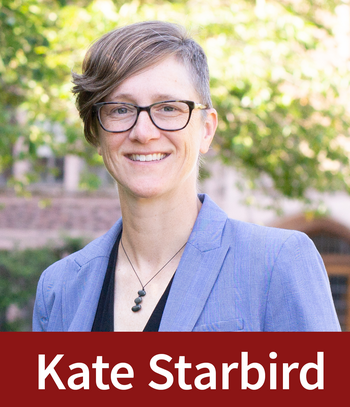
Kate Starbird
Abstract:

This talk describes the disinformation campaign targeting the Syria Civil Defense (or “White Helmets”), a humanitarian response group that works in rebel held areas of Syria. The White Helmets provide medical aid, search, and rescue to people affected by the civil war in Syria. They also document the impacts of atrocities — including airstrikes and chemical weapons attacks — perpetrated by the Syrian regime and their Russian allies. For several years, the White Helmets have been the target of a campaign to undermine and delegitimize their work. In this talk, I describe a multi-study research effort that reveals how this multi-dimensional, cross-platform campaign “works” — including a look at the media ecosystems that support the campaign, the networks of actors who collaborate to produce and spread its narratives (including government agents and “unwitting crowds” of online activists), and the “work” that these actors participate in, using the affordances of social media platforms to connect, recruit, organize, promote their messages, attack opposing messages, and otherwise advance the goals of their campaign. 

Kate Starbird Bio


Paragraphs

In these early days of the regulatory renaissance for digital technologies, China, Europe, and the United States are competing over whose image will be most reflected in market-defining rules and norms. Despite new lows in the trans-Atlantic relationship in the era of Trump, Europe and the United States still have far more in common with each other about how technology should be developed, deployed, and regulated than they do with China.


All Publications button
1
Publication Type
Commentary
Publication Date
Authors
Subscribe to International Relations