Governance

FSI's research on the origins, character and consequences of government institutions spans continents and academic disciplines. The institute’s senior fellows and their colleagues across Stanford examine the principles of public administration and implementation. Their work focuses on how maternal health care is delivered in rural China, how public action can create wealth and eliminate poverty, and why U.S. immigration reform keeps stalling. 

FSI’s work includes comparative studies of how institutions help resolve policy and societal issues. Scholars aim to clearly define and make sense of the rule of law, examining how it is invoked and applied around the world. 

FSI researchers also investigate government services – trying to understand and measure how they work, whom they serve and how good they are. They assess energy services aimed at helping the poorest people around the world and explore public opinion on torture policies. The Children in Crisis project addresses how child health interventions interact with political reform. Specific research on governance, organizations and security capitalizes on FSI's longstanding interests and looks at how governance and organizational issues affect a nation’s ability to address security and international cooperation.

-

Image
cloud governance event with speaker photos of kelly born, marietje schaake

Join us for our winter seminar series starting Tuesday, January 11 from 12 PM - 1 PM PST.  The first in the session is Cloud Governance Challenges and features leaders from the Carnegie Endowment’s Cloud Governance Project and Marietje Schaake of the Stanford Cyber Policy Center, in conversation with Kelly Born of the Hewlett Foundation. This weekly seminar series is jointly organized by the Cyber Policy Center’s Program on Democracy and the Internet and the Hewlett Foundation’s Cyber Initiative.

Central to the ongoing digital transformation is the growth of cloud computing, which is enabling remarkable gains in efficiency, innovation, and connectivity around the world. However, the cloud also accentuates many preexisting digital policy challenges and brings to the fore new ones. It increases the consequences of disruption resulting from cyberattacks and natural disasters, and raises the stakes associated with ensuring equitable access to the digital environment. It also creates some new challenges associated with the concentration of the cloud market in the hands of a few hyperscale providers. Left to their own devices, cloud providers lack the incentives to comprehensively address these issues, and governments’ ability to fill the gap is being challenged by the pace of the developments in the cloud technology landscape. To promote more coherent and effective governance of the cloud, concerned players must recognize the challenges, interconnections, and policy tradeoffs across issue areas. They will need to apply a combination of regulation, self-regulation, and industry standards, while balancing competing private, national, and international interests. 

Speakers:

Kelly Born, Director, Cyber Initiative, William and Flora Hewlett Foundation

Ariel Eli Levite, Nonresident Senior Fellow, Carnegie Endowment for International Peace

Vishnu Kannan, Special Assistant to the President, Carnegie Endowment for International Peace

Marietje Schaake, International Policy Director, Cyber Policy Center
 

0
John Perrino

John Perrino received his undergraduate and MPA at the George Washington University, focusing on internet policy and political communication. At the Stanford Internet Observatory he works on expanding policy strategy and working to build SIO's presence in DC. 

He previously held positions with GW’s Columbian College of Arts and Sciences and Elliott School of International Affairs. Perrino got his start in Internet policy as a Communications Fellow at the Internet Education Foundation, helping organize and promote Capitol Hill briefings and the annual State of the Net conference. He was most recently a Director at Glen Echo Group.


Former Policy Analyst, Stanford Internet Observatory, Cyber Policy Center
Date Label
-


Image
David Kaye event, the global spyware crisis and how to stop it

Join us November 2nd from 12 PM - 1 PM PT for “The Global Spyware Crisis and How to Stop It” featuring David Kaye, professor of law at University of California, Irvine, and moderated by Kelly Born, director of the Cyber Initiative at the William and Flora Hewlett Foundation. This seminar series is organized by the Cyber Policy Center’s Program on Democracy and the Internet and the Hewlett Foundation’s Cyber Initiative. 

The private surveillance (or spyware) industry has thrived with low levels of transparency and public scrutiny and weak controls on transfers of technology. Governments offer limited information on the use of surveillance products and regulations of private surveillance companies. Meanwhile, these tools – most famously but not exclusively the Pegasus malware of the Israeli NSO Group – are increasingly used against journalists, opposition figures, those in dissent, and others. Public reporting – particularly energized by release of the Pegasus Project reporting by the Forbidden Stories consortium in the summer of 2021 – has begun to generate increasing global concern, and yet policy and law lag far behind. This presentation will focus on a human rights-based legal and policy framework for the regulation and accountability of, as well as transparency within, the private surveillance industry.

Speaker Profile:

David Kaye is a professor of law at the University of California, Irvine, director of its International Justice Clinic, and co-director of the Center on Fair Elections and Free Speech. From 2014 – 2020 he served as the United Nations Special Rapporteur on the promotion and protection of the right to freedom of opinion and expression. Author of Speech Police: The Global Struggle to Govern the Internet (2019), he is currently Independent Chair of the Board of the Global Network Initiative and a Trustee of ARTICLE 19.


David Kaye Professor of Law, UC Irvine
-

Image
jawboning as a first amendment problem

PART OF THE FALL SEMINAR SERIES

Join us on October 19th for our weekly seminar from 12 PM - 1 PM PT featuring Genevieve Lakier, Professor of Law at University of Chicago's Law School and CPC Co-Director, Nate Persily. This series is organized by the Program on Democracy and the Internet, and the Cyber Initiative at the William and Flora Hewlett Foundation.

For years now, scholars have expressed alarm at the tendency of government officials to pressure—or “jawbone”—social media companies into taking down what the officials consider to be harmful or offensive speech, even when no law requires it. Scholars have worried, for good reason, that the practice of jawboning allows government officials to evade the stringent constraints on their power to regulate speech imposed by the First Amendment. But relatively little attention has been paid to the constitutional question of whether, or rather when, government jawboning itself violates the First Amendment. In fact, answering this question turns out to be quite difficult because of deep inconsistencies in the cases that deal with jawboning, both in the social media context and beyond. In this talk, I will explore what those inconsistencies are, why the case law is so unclear about where the line between permissible government pressure and unconstitutional governmental coercion falls, and what kind of jawboning rule might be necessary to protect free speech values in a public sphere in which both private companies and government officials possess considerable power to determine who can and cannot speak.


REGISTER


Speaker Profile:

Genevieve Lakier teaches and writes about freedom of speech and American constitutional law. Her work examines the changing meaning of freedom of speech in the United States, the role that legislatures play in safeguarding free speech values, and the fight over freedom of speech on the social media platforms.
 
Genevieve has an AB from Princeton University, a JD from New York University School of Law, and an MA and PhD in anthropology from the University of Chicago. Between 2006 and 2008, she was an Academy Scholar at the Weatherhead Center for International and Area Studies at Harvard University. After law school, she clerked for Judge Leonard B. Sand of the Southern District of New York and Judge Martha C. Daughtrey of the Sixth Circuit Court of Appeals. Before joining the faculty, Genevieve taught at the Law School as a Bigelow Fellow and Lecturer in Law. She will serve as the Senior Visiting Research Scholar at the Knight Institute at Columbia University for the 2021-2022 school year, where she will be supervising a project exploring the relationship between the First Amendment and the regulation of lies, disinformation and misinformation.


Genevieve Lakier,
Seminars

Shorenstein APARC

Encina Hall

Stanford University

0
APARC Predoctoral Fellow, 2021-2022
Stanford Internet Observatory Postdoctoral Fellow, 2022-2023
tongtong_zhang.jpg

Tongtong Zhang joins the Walter H. Shorenstein Asia-Pacific Research Center (APARC) as APARC Predoctoral Fellow for the 2021-2022 academic year. She is a Ph.D candidate at the department of Political Science at Stanford University. Her research focuses on authoritarian deliberation and responsiveness in China.

Date Label
-

Image
Soojong Kim event flyer for October 12th showing his face and name of event

PART OF THE FALL SEMINAR SERIES

Join us at the weekly Cyber Policy Center (CPC) seminar on Tue, October 12th from 12 PM - 1 PM PST featuring Soojong Kim, postdoctoral fellow at the Program on Democracy and the Internet. This session will be moderated by Co-Director of the CPC, Nate Persily. This is part of the fall seminar series organized by the Program on Democracy and the Internet, and the William and Flora Hewlett Foundation’s Cyber Initiative.

There has been growing concern about online misinformation and falsehood. It has been suspected that the proliferation of misleading narratives is especially severe on Facebook, the world’s largest social media site, but there has been a lack of large-scale systematic investigations on these issues. This talk will introduce a series of ongoing research projects investigating online groups promoting misleading narratives on Facebook, including anti-vaccine groups, climate change denialists, countermovements against racial justice movements, and conspiracy theorists. The presentation will discuss the prevalence, characteristics, ecosystem of misleading narratives on Facebook, and implications for potential interventions.


REGISTER


Speaker Profile:

Soojong Kim is a postdoctoral fellow, jointly affiliated with the Program on Democracy and the Internet (PDI) and the Digital Civil Society Lab (DCSL) at Stanford University. He received his Ph.D. at the Annenberg School for Communication, University of Pennsylvania. His research centers around digital media, social networks, and information propagation. As a former computer scientist, he is also interested in developing and applying computational methods, including online experiments, large-scale data analysis, and computational modeling.


Seminars
-

Image
out of the rabbit hole event flyer with photo of becca lewis

PART OF THE FALL SEMINAR SERIES

Join us on October 5th at the Cyber Policy Center seminar from 12 PM - 1 PM PST featuring Becca Lewis, PhD Candidate in Communication at Stanford University. The session will be moderated by Kelly Born, Director of the Cyber Initiative at the William and Flora Hewlett Foundation. 

Conventional wisdom suggests that conspiracy theories and far-right propaganda thrive mainly at the end of algorithmic rabbit holes, in the deep, dark corners of the internet. This presentation will show that the opposite is true by explaining how in fact, harmful ideas gain traction through the charisma and popularity of internet celebrities in mainstream social media contexts. Through her extensive research on far-right YouTubers, Becca Lewis argues that instead of merely focusing our responses on the threat of algorithmic rabbit holes, we must also understand the power of amplification through thriving alternative media systems on- and offline.


REGISTER


Speaker Profile:

Becca Lewis is a Stanford Graduate Fellow and PhD candidate in Communication at Stanford University, as well as a research affiliate at Data & Society Research Institute and the University of North Carolina’s Center for Information, Technology, and Public Life. Her research has been published in the journals Society Media + Society, Television and New Media, and American Behavioral Scientist, and her public writing has appeared in outlets including The Guardian, New York Magazine, and Columbia Journalism Review. She holds an MSc in Social Science from the Oxford Internet Institute.


Becca Lewis Stanford Graduate Fellow and PhD candidate in Communication at Stanford University
Seminars
-

Image
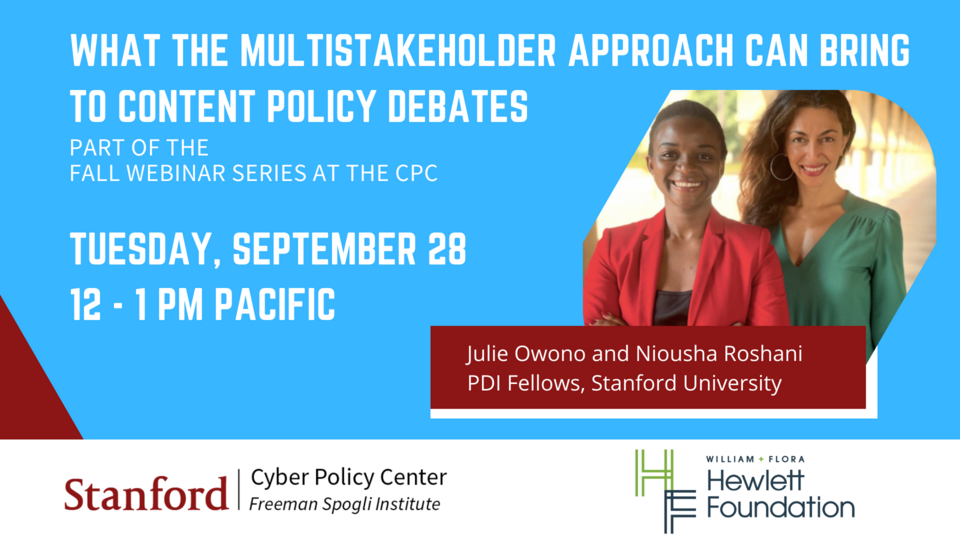
Julie Owono & Dr. Niousha Roshani Event September 28

PART OF THE FALL SEMINAR SERIES

Join us via Zoom on Tue, September 28th from 12 PM - 1 PM PST for a conversation with PDI fellows, Julie Owono and Dr Niousha Roshani, moderated by Co-Director of the Cyber Policy Center, Nathaniel Persily, as they discuss the challenges to content policy and the solutions that a multistakeholder approach has to offer. This is part of the fall seminar series organized by Stanford Cyber Policy Center’s Program on Democracy and the Internet, and the William and Flora Hewlett Foundation’s Cyber Initiative. 


REGISTER


The multistakeholder governance model is increasingly presented as a solution for addressing content governance issues online. While this inclusive and collaborative approach mirrors the foundational principle of an “open and free internet”, challenges with online content around scale and rapidity notably, call for further experimentation. 

The Content Policy & Society Lab (CPSL), a new project of the Program on Democracy and the Internet (PDI) at Stanford’s Cyber Policy Center (CPC), aims to be one of these experiments - by creating a safe space for a diverse array of stakeholders from government, the private sector, civil society, and academia to share knowledge and collaborate on solutions.

Moderator: Nathaniel Persily, Co-Director, Cyber Policy Center

Speakers: Julie Owono, PDI Fellow and Niousha Roshani, PDI Fellow


Julie Owono
Niousha Roshani
Seminars
-

Image
header for Technology and Geopolitics: EU Proposals for Regulating Rights, Security and Trade

The future of technology policy in Europe will be affected by growing nationalism and protectionism, cyber and national security threats, and great power rivalries. The Program on Democracy and the Internet invites you to a technology policy discussion led by International Policy Director, Marietje SchaakeJoin us on September 16th from 9 AM - 12 PM PST (6 PM - 9 PM CET), as we dive into conversations on EU legislative packages, digital trade rules, and cybersecurity & geopolitics. We hope to develop a more precise understanding of how the EU and its allies can collaborate to create compatible technology standards, build more resilient supply chains, and address novel opportunities and risks presented by emerging technologies.This event is organized by the Program on Democracy and the Internet (part of the Cyber Policy Center and the Center on Philanthropy and Civil Society) and co-sponsored by the Institute for Human-Centered Artificial Intelligence.

Moderators: 


Speakers:


Seminars
All Publications button
1
Publication Type
Conference Memos
Publication Date
Subtitle
The Project on Middle East Political Science partnered with Stanford University’s Center for Democracy, Development and the Rule of Law and its Global Digital Policy Incubator for an innovative two week online seminar to explore the issues surrounding digital activism and authoritarianism. This workshop was built upon more than a decade of our collaboration on issues related to the internet and politics in the Middle East, beginning in 2011 with a series of workshops in the “Blogs and Bullets” project supported by the United States Institute for Peace and the PeaceTech Lab. This new collaboration brought together more than a dozen scholars and practitioners with deep experience in digital policy and activism, some focused on the Middle East and others offering a global and comparative perspective. POMEPS STUDIES 43 collects essays from that workshop, shaped by two weeks of public and private discussion.
Authors
Larry Diamond
Shelby Grossman
Subscribe to Governance