Society

FSI researchers work to understand continuity and change in societies as they confront their problems and opportunities. This includes the implications of migration and human trafficking. What happens to a society when young girls exit the sex trade? How do groups moving between locations impact societies, economies, self-identity and citizenship? What are the ethnic challenges faced by an increasingly diverse European Union? From a policy perspective, scholars also work to investigate the consequences of security-related measures for society and its values.

The Europe Center reflects much of FSI’s agenda of investigating societies, serving as a forum for experts to research the cultures, religions and people of Europe. The Center sponsors several seminars and lectures, as well as visiting scholars.

Societal research also addresses issues of demography and aging, such as the social and economic challenges of providing health care for an aging population. How do older adults make decisions, and what societal tools need to be in place to ensure the resulting decisions are well-informed? FSI regularly brings in international scholars to look at these issues. They discuss how adults care for their older parents in rural China as well as the economic aspects of aging populations in China and India.

-

Image
Image of Marietje Schaake, Jessica Gonzalez and David Sifry, speaking on stopping hate for profit
Tech companies are not doing enough to fight hate on their digital social platforms. But what can be done to encourage social platforms to provide more support to people who are targets of racism and hate, and to increase safety for private groups on the platform?

Join host Marietje Schaake, International Policy Director at the Cyber Policy Center, as she brings together experts from the space, to speak about what can be done to encourage platforms like Facebook to stop the spread of hate and disinformation. 

The event is open to the public, but registration is required:

Maritje Schaake: Marietje Schaake is the international policy director at Stanford University’s Cyber Policy Center and international policy fellow at Stanford’s Institute for Human-Centered Artificial Intelligence. She was named President of the Cyber Peace Institute. Between 2009 and 2019, Marietje served as a Member of European Parliament for the Dutch liberal democratic party where she focused on trade, foreign affairs and technology policies. Marietje is affiliated with a number of non-profits including the European Council on Foreign Relations and the Observer Research Foundation in India and writes a monthly column for the Financial Times and a bi-monthly column for the Dutch NRC newspaper. 

Jessica Gonzalez: An accomplished attorney and racial-justice advocate, Jessica works closely with the executive team and key stakeholders to develop and execute strategies to advance Free Press’ mission. A former Lifeline recipient, Jessica has helped fend off grave Trump administration cuts to the program, which helps provide phone-and-internet access for low-income people. She was part of the legal team that overturned a Trump FCC decision blessing runaway media consolidation. She also co-founded Change the Terms, a coalition of more than 50 civil- and digital-rights groups that works to disrupt online hate. Previously, Jessica was the executive vice president and general counsel at the National Hispanic Media Coalition, where she led the policy shop and helped coordinate campaigns against racist and xenophobic media programming. Prior to that she was a staff attorney and teaching fellow at Georgetown Law’s Institute for Public Representation. Jessica has testified before Congress on multiple occasions, including during a Net Neutrality hearing in the House while suffering from acute morning sickness, and during a Senate hearing while eight months pregnant to advocate for affordable internet access.

David Sifry: As Vice President of the Center for Technology and Society (CTS), Dave Sifry leads a team of innovative technologists, researchers, and policy experts developing proactive solutions and producing cutting-edge research to protect vulnerable populations. In its efforts to advocate change at all levels of society, CTS serves as a vital resource to legislators, journalists, universities, community organizations, tech platforms and anyone who has been a target of online hate and harassment. Dave joined ADL in 2019 after a storied career as a technology entrepreneur and executive. He founded six companies including Linuxcare and Technorati, and served in executive roles at companies including Lyft and Reddit. In addition to his entrepreneurial work, Dave was selected as a Technology Pioneer at The World Economic Forum, and is an advisor and mentor for a select group of companies and startup founders. As the son of a hidden child of the Holocaust, the core values and mission exemplified by ADL were instilled in him at an early age.

Panel Discussions
-
Image
The rise of digital authoritarianism banner advertisement

There will be four events, with the first on September 29th; all dates listed below

REGISTER

  • September 29th, 9-11am PST
  • October 1st, 9-11am PST
  • October 6th, 9-11am PST
  • October 9th, 9-11am PST


The Rise of Digital Authoritarianism: China, AI and Human Rights

Day 1- September 29, 2020

Welcome Remarks

Larry Diamond | Senior Fellow, Hoover Institution and FSI, Principal Investigator, Global Digital Policy Incubator

Glenn Tiffert | Research Fellow, Hoover Institution

Jenny Wang | Strategic Advisor, Human Rights Foundation

Opening Remarks

Condoleezza Rice | Director, Hoover Institution, Former U.S. Secretary of State, Denning Professor in Global Business at the Graduate School of Business


Panel 1: How AI is powering China's Domestic Surveillance State - How is AI exacerbating surveillance risks and enabling digital authoritarianism? This session will examine both state-sponsored applications and Chinese commercial services.

Panelists

Bethany Allen-Ebrahimian | China Reporter, Axios

Paul Mozur | Asia Technology Correspondent, New York Times

Glenn Tiffert | Research Fellow, Hoover Institution

Xiao Qiang | UC Berkeley & Editor-in-Chief, China Digital Times

Moderator

Melissa Chan | Foreign Affairs Reporter, Deutsche Welle Asia


Day 2- October 1, 2020

Panel 2: The Ethics of Doing Business with China and Chinese Companies

Eric Schmidt | Former Executive Chairman and CEO, Google//Co-Founder, Schmidt Futures
Conversant: Eileen Donahoe, Executive Director of GDPI


Panel 2: The Ethics of Doing Business with China and Chinese Companies - What dynamics are at play in China's effort to establish market dominance for Chinese companies, both domestically and globally? What demands are placed on non-Chinese technology companies to participateWhat dynamics are at play in China's effort to establish market dominance for Chinese companies, both domestically and globally? What demands are placed on non-Chinese technology companies to participate in the Chinese marketplace? What framework should U.S.-based companies use to evaluate the risks and opportunities for collaboration and market entry in China? To what extent are Chinese companies (e.g..,TikTok) competing in Western markets required to comply with Chinese government instructions or demands for access to data?

Panelists

Mary Hui | Hong Kong-based Technology and Business Reporter, Quartz
 
Megha Rajagopalan | International Correspondent and Former China Bureau Chief, Buzzfeed News
 

Alex Stamos | Director, Stanford Internet Observatory & Former Chief Security Officer, Facebook

Moderator

Casey Newton | Silicon Valley Editor, The Verge


Day 3- October 6, 2020

Panel 3: China as an Emerging Global AI Superpower

Keynote & Conversation

Competing in the Superpower Marathon with China

Mike Brown | Director, Defense Innovation Unit

Conversant: Larry Diamond, Senior Fellow, Hoover Institution and FSI, Principal Investigator, Global Digital Policy Incubator

Panel 3: China as an Emerging Global AI Superpower- How should we think about China's growing influence in the realm of AI and the attendant geopolitical risks and implications? This session will explore China’s bid through Huawei to build and control the world's 5G networks, and what that implies for human rights and national sovereignty and security; China's export of surveillance technology to authoritarian regimes around the world; China's global partnerships to research and develop AI; and the problem of illicit technology transfer/theft.

Panelists

Steven Feldstein | Senior Fellow, Carnegie Endowment for International Peace 

Lindsay Gorman | Fellow for Emerging Technologies, Alliance for Securing Democracy, German Marshall Fund 

Maya Wang | China Senior Researcher, Human Rights Watch

Moderator

Dominic Ziegler | Senior Asia Correspondent and Banyan Columnist, The Economist


Day 4- October 9, 2020

Panel 4: How Democracies Should Respond to China’s Emergence as an AI Superpower

Keynote

Digital Social Innovation: Taiwan Can Help

Audrey Tang | Digital Minister, Taiwan

Panel 4: How Democracies Should Respond to China's Emergence as an AI Superpower- How should the rest of the world, and especially the world's democracies, react to China's bid to harness AI for ill as well as good? How do we strike the right balance between vigilance in defense of human rights and national security and xenophobic overreaction?

Panelists

Christopher Balding | Associate Professor, Fulbright University Vietnam

Anja Manuel | Co-Founder, Rice, Hadley, Gates & Manuel

Chris Meserole | Deputy Director of the Artificial Intelligence and Emerging Technology Initiative, Brookings Institution

Moderator

Larry Diamond | Senior Fellow, Hoover Institution and FSI, Principal Investigator, Global Digital Policy Incubator


Closing Keynote & Conversation

Strengthening Human-Centered Artificial Intelligence

Fei-Fei Li | Co-Director, Stanford Institute for Human-Centered Artificial Intelligence (HAI) Conversant: Eileen Donahoe, Executive Director of GDPi

Closing Remarks: Alex Gladstein & Eileen Donahoe
Seminars
Date Label
-

Image
towards cyber peace

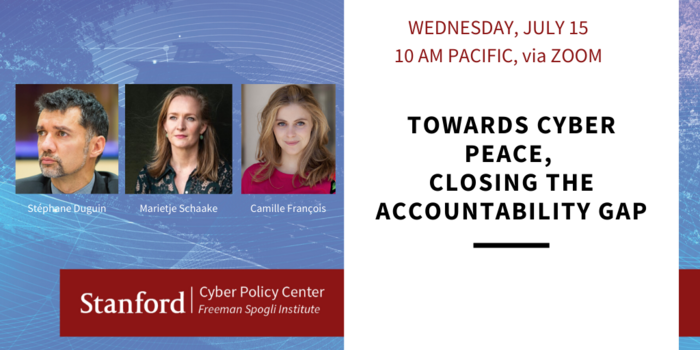
Please join the Cyber Policy Center for Towards Cyber Peace, Closing the Accountability Gap, hosted by Cyber Policy Center's Marietje Schaake, along with guests Stéphane Duguin, CEO of the Cyber Peace Institute and Camille François, CIO of Graphika and Mozilla Fellow. The discussion will focus on the challenges to cyber peace, and the work being done to chart a path forward. The session is open to the public, but registration is required. 

Marietje Schaake is the international policy director at Stanford University’s Cyber Policy Center and international policy fellow at Stanford’s Institute for Human-Centered Artificial Intelligence. She was named President of the Cyber Peace Institute. Between 2009 and 2019, Marietje served as a Member of European Parliament for the Dutch liberal democratic party where she focused on trade, foreign affairs and technology policies. Marietje is affiliated with a number of non-profits including the European Council on Foreign Relations and the Observer Research Foundation in India and writes a monthly column for the Financial Times and a bi-monthly column for the Dutch NRC newspaper. 

Camille François works on cyber conflict and digital rights online. She is the Chief Innovation Officer at Graphika, where she leads the company’s work to detect and mitigate disinformation, media manipulation and harassment. Camille was previously the Principal Researcher at Jigsaw, an innovation unit at Google that builds technology to address global security challenges and protect vulnerable users. Camille has advised governments and parliamentary committees on both sides of the Atlantic on policy issues related to cybersecurity and digital rights. She served as a special advisor to the Chief Technology Officer of France in the Prime Minister’s office, working on France’s first Open Government roadmap. Camille is a Mozilla Fellow, a Berkman-Klein Center affiliate, and a Fulbright scholar. She holds a masters degree in human rights from the French Institute of Political Sciences (Sciences-Po) and a masters degree in international security from the School of International and Public Affairs (SIPA) at Columbia University. François’ work has been featured in various publications, including the New York Times, WIRED, Washington Post, Bloomberg Businessweek, Globo and Le Monde.

Stéphane Duguin is the Chief Executive Officer of the CyberPeace Institute. His mission is to coordinate a collective response to decrease the frequency, impact, and scale of cyberattacks by sophisticated actors. Building on his hands-on experience in countering and analyzing cyber operations and information operations which impact civilians and civilian infrastructure, he leads the Institute with the aim of holding malicious actors to account for the harms they cause. Prior to this position, Stéphane Duguin was a senior manager and innovation coordinator at Europol. He led key operational projects to counter both cybercrime and online terrorism, such as the setup of the European Cybercrime Centre (EC3), the Europol Innovation Lab, and the European Internet Referral Unit (EU IRU). A leader in digital transformation, his work focused on the implementation of innovative responses to a large-scale abuse of the cyberspace, notably on the convergence of disruptive technologies and public-private partnerships.


Image
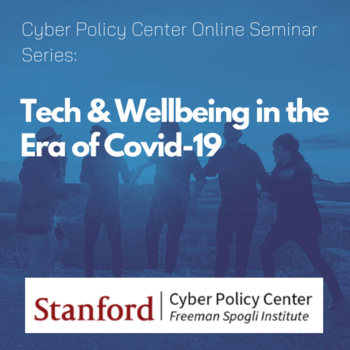
Tech and Wellbeing in the Era of Covid-19
Please join the Cyber Policy Center for Tech & Wellbeing in the Era of Covid-19 with Jeff Hancock from Stanford University, Amy Orben from Emmanuel College, and Erica Pelavin, Co-Founder of My Digital TAT2, in conversation with Kelly Born, Executive Director of the Cyber Policy Center. The session will explore the risks and opportunities technologies pose to users’ wellbeing; what we know about the impact of technology on mental health, particularly for teens; how the current pandemic may change our perceptions of technology; and ways in which teens are using apps, influencers and platforms to stay connected under Covid-19.


Dr. Amy Orben is College Research Fellow at Emmanuel College and the MRC Cognition and Brain Sciences Unit. Her work using large-scale datasets to investigate social media use and teenage mental health has been published in a range of leading scientific journals. The results have put into question many long-held assumptions about the potential risks and benefits of ’screen time'. Alongside her research, Amy campaigns for the use of improved statistical methodology in the behavioural sciences and the adoption of more transparent and open scientific practices, having co-founded the global ReproducibiliTea initiative. Amy also regularly contributes to both media and policy debate, having recently given evidence to the UK Commons Science and Technology Select Committee and various governmental investigations.

Jeff Hancock is founding director of the Stanford Social Media Lab and is a Professor in the Department of Communication at Stanford University. Professor Hancock and his group work on understanding psychological and interpersonal processes in social media. The team specializes in using computational linguistics and experiments to understand how the words we use can reveal psychological and social dynamics, such as deception and trust, emotional dynamics, intimacy and relationships, and social support. Recently Professor Hancock has begun work on understanding the mental models people have about algorithms in social media, as well as working on the ethical issues associated with computational social science.

Erica Pelavin, is an educator, public speaker, and Co-Founder and Director of Teen Engagement at My Digital TAT2. Working from a strength-based perspective, Erica has expertise in bullying prevention, relational aggression, digital safety, social emotional learning, and conflict resolution. Dr. Pelavin has a passion for helping young people develop the skills to become their own advocates and cares deeply about helping school communities foster empathy and respect. In her role at My Digital TAT2, Erica leads all programming for high schoolers including the youth led podcast Media in the Middle, the teen advisory boards and an annual summer internship program. Her work with teens directly impacts and informs the developmental school based curriculum. Erica is also a high school counselor at Eastside College Prep in East Palo Alto, CA.

Watch the recorded session

News Type
Blogs
Date
Paragraphs

From the Stanford Institute for Human-Centered AI (HAI) blog:

More than 25 governments around the world, including those of the United States and across the European Union, have adopted elaborate national strategies on artificial intelligence — how to spur research; how to target strategic sectors; how to make AI systems reliable and accountable.

Yet a new analysis finds that almost none of these declarations provide more than a polite nod to human rights, even though artificial intelligence has potentially big impacts on privacy, civil liberties, racial discrimination, and equal protection under the law.

That’s a mistake, says Eileen Donahoe, executive director of Stanford’s Global Digital Policy Incubator, which produced the report in conjunction with a leading international digital rights organization called Global Partners Digital.

Read More (at the HAI blog)

Hero Image
Global Flags
All News button
1
Subtitle

In the rush to develop national strategies on artificial intelligence, a new report finds, most governments pay lip service to civil liberties.

-

Join Cyber Policy Center, June 17rd at 10am Pacific Time for Patterns and Potential Solutions to Disinformation Sharing, Under COVID-19 and Beyond, with Josh Tucker, David Lazer and Evelyn Douek.

The session will explore which types of readers are most susceptible to fake news, whether crowdsourced fact-checking by ordinary citizens works and whether it can reduce the prevalence of false news in the information ecosystem. Speakers will also look at patterns of (mis)information sharing regarding COVID-19: Who is sharing what type of information? How has this varied over time? How much misinformation is circulating, and among whom? Finally, we'll explore how social media platforms are responding to COVID disinformation, how that differs from responses to political disinformation, and what we think they could be doing better.

Evelyn Douek is a doctoral candidate and lecturer on law at Harvard Law School, and Affiliate at the Berkman Klein Center For Internet & Society. Her research focuses on online speech governance, and the various private, national and global proposals for regulating content moderation.

David Lazer is a professor of political science and computer and information science and the co-director of the NULab for Texts, Maps, and Networks. Before joining the Northeastern faculty in fall 2009, he was an associate professor of public policy at Harvard’s John F. Kennedy School of Government and director of its Program on Networked Governance. 

Joshua Tucker is Professor of Politics, Director Jordan Center for the Advanced Study of Russia, Co-Director NYU Social Media and Political Participation (SMaPP) lab, Affiliated Professor of Russian and Slavic Studies and Affiliated Professor of Data Science.

The event is open to the public, but registration is required.

Online, via Zoom

News Type
Commentary
Date
All News button
1
Subtitle

On May 28th, President Trump signed an executive order threatening to revoke CDA 230 protections, which would expose social media companies to increased liability for content that is posted on their sites. The Cyber Policy Center team responded on June 1 in a public webinar. The event was recorded.

-

On Thursday, President Trump signed an executive order threatening to revoke CDA 230 protections, which would expose social media companies to increased liability for content that is posted on their sites. This comes on the heels of Twitter, last week, fact-checking two misleading tweets from the president about mail-in voting. Critics of the executive order say the White House is overstepping its authority, and cannot limit the legal protections that social media companies currently hold under federal law.
 
Join the Stanford Cyber Policy Center's team Monday June 1 at 8AM PST for President Trump’s Executive Order on Platforms and Online Speech: Stanford’s Cyber Policy Center Responds, with Nate Persily, Faculty Co-Director of the Cyber Policy Center and Director of the Program on Democracy and the Internet; Daphne Keller, Director for the Program on Platform Regulation and former associate general counsel for Google; Alex Stamos, Director of the Cyber Center’s Internet Observatory and former Chief Security Officer at Facebook; Marietje Schaake, Policy Director for the Cyber Policy Center and former Member of EU Parliament; and Eileen Donahoe, Executive Director of the Global Digital Policy Incubator and former US Ambassador to the UN Human Rights Counsel, in conversation with Cyber Center Director Kelly Born.

Monday, June 1st
8am PDT
Join via Zoom

Panel Discussions
-

Join Cyber Policy Center, June 3rd at 10am PST for The Accelerated Shift to Online Retail Under Covid-19, and Risks Associated with Underlying Dynamic Pricing Technologies with Christo Wilson at Northeastern University and Ramsi Woodcock at University of Kentucky.

The hallmarks of the Covid-19 (a shortage of masks, hand sanitizer, food, along with an acceleration of the shift to online retail) are affording retailers the opportunity to use the dynamic pricing technologies already ubiquitous in online retail in order to ration access to goods that are in temporarily short supply. In a time of crisis, dynamic pricing may run afoul of state laws prohibiting price gouging. But the practice also raises important questions about both the equity of rationing with price and the safety of doing so. Dynamic pricing online may be pricing less wealthy Americans out of online goods and services, forcing them into riskier in-person transactions at brick and mortar store locations. Fortunately, the same technologies that make dynamic pricing possible also make more equitable alternatives to rationing with price cheap and effective for online retailers. 

Seminars
-

On May 20th please join us for Perspectives on Science Communication, Misinformation, and the COVID-19 Infodemic, featuring University of Washington scholars Kate Starbird, Jevin West and Ryan Calo, in conversation with Cyber Policy Center Director Kelly Born, as they discuss a new project exploring how scientific findings and science credentials are mobilized in the spread of misinformation.

Kate Starbird and Jevin West will present emerging research into how scientific findings and science credentials are mobilized within the spread of false and misleading information about COVID-19. Ryan Calo will explore proposals to address COVID-19 through information technology—the subject of a recent Senate Commerce hearing at which he testified—with particular attention to the ways contact tracing apps could prove a vector for misinformation and disinformation. 


May 20, 10am-11am (PST)
Join via Zoom 

Kate StarbirdKate Starbird is an Associate Professor in the Department of Human Centered Design & Engineering (HCDE) and Director of the Emerging Capacities of Mass Participation (emCOMP) Laboratory. She is also adjunct faculty in the Paul G. Allen School of Computer Science & Engineering and the Information School and a data science fellow at the eScience Institute. 

Kate's research is situated within human-computer interaction (HCI) and the emerging field of crisis informatics — the study of how information-communication technologies (ICTs) are used during crisis events. Her research examines how people use social media to seek, share, and make sense of information after natural disasters (such as earthquakes and hurricanes) and man-made disasters (such as acts of terrorism and mass shooting events). More recently, her work has shifted to focus on the spread of disinformation in this context. 

Ryan Calo
Ryan Calo
 is the Lane Powell and D. Wayne Gittinger Associate Professor at the University of Washington School of Law. In addition to co-founding the UW Center for an Informed Public, he is a faculty co-director (with Batya Friedman and Tadayoshi Kohno) of the UW Tech Policy Lab---a unique, interdisciplinary research unit that spans the School of Law, Information School, and Paul G. Allen School of Computer Science and Engineering where Calo also holds courtesy appointments. Calo is widely published in the area of law and emerging technology. 


Jevin WestJevin West is an Associate Professor in the Information School at the University of Washington. He is the co-founder of the DataLab and the new Center for an Informed Public at UW. He holds an Adjunct Faculty position in the Paul G. Allen School of Computer Science & Engineering and Data Science Fellow at the eScience Institute. His research and teaching focus on misinformation in and about science. He develops methods for mining the scientific literature in order to study the origins of disciplines, the social and economic biases that drive these disciplines, and the impact the current publication system has on the health of science. 


Kelly Born
Kelly Born
 is the Executive Director of Stanford’s Cyber Policy Center. The center’s research and teaching focuses on the governance of digital technology at the intersection of security, geopolitics and democracy. Born collaborates with the center’s program leaders to pioneer new lines of research, policy-oriented curriculum, and outreach to key decision-makers globally. Prior to joining Stanford, Born helped to launch and lead The Madison Initiative at the William and Flora Hewlett Foundation, one of the largest philanthropic undertakings working to reduce polarization and improve U.S. democracy. There, she designed and implemented strategies focused on money in politics, electoral reform, civic engagement and digital disinformation. Kelly earned a master’s degree in international policy from Stanford University. 

Kate Starbird
Ryan Calo
Jevin West
Seminars
Subscribe to Society