Democracy promotion
0
renee-diresta.jpg

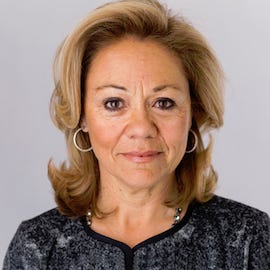
Renée DiResta is the former Research Manager at the Stanford Internet Observatory. She investigates the spread of malign narratives across social networks, and assists policymakers in understanding and responding to the problem. She has advised Congress, the State Department, and other academic, civic, and business organizations, and has studied disinformation and computational propaganda in the context of pseudoscience conspiracies, terrorism, and state-sponsored information warfare.

You can see a full list of Renée's writing and speeches on her website: www.reneediresta.com or follow her @noupside.


Former Research Manager, Stanford Internet Observatory
Authors
News Type
Blogs
Date
Paragraphs

Facebook and Congress Must Create Regulations Together

Featuring Eileen Donahoe, executive director of the Global Digital Policy Incubator and Allison Berke, executive director of the Stanford Cyber Initiative. Both programs are housed at the Freeman Spogli Institute for International Studies (FSI). Written by Nicole Feldman.

For the past two days, the United States Senate and House of Representatives grilled Facebook CEO Mark Zuckerberg on everything from user privacy to platform bias to Russian interference in the 2016 elections. Though prompted by Cambridge Analytica’s improper use of user data, Zuckerberg’s testimony provided a broader platform to talk about Facebook’s role in today’s increasingly digital world and regulation for the tech industry as a whole. FSI scholars Eileen Donahoe and Allison Berke give us their top take-aways from Zuckerberg’s testimony.

 
Photo of Eileen Donahoe

Eileen Donahoe


There were two big “take-aways” from Mark Zuckerberg’s testimony before Congress this week.

Digital privacy is a form of security that matters to Facebook users and to citizens in our democracy.

The good news that came out of the hearings is that the American public and our representatives in Congress are waking up to the importance of citizens’ privacy in our democracy, as well as to the consequences of the loss of privacy for freedom and security. The Cambridge Analytica — Facebook saga has succeeded in bringing to public consciousness a significant security threat to our democracy, which until now has been relatively invisible in public debate: how failure to protect user’s digital privacy can have real world consequences for democratic processes, national security, and citizens’ liberty. Earlier un-nuanced assertions expressed by many in the technology community that “privacy is over” and users don’t care about how their data is shared, can no longer function as a dominant operating assumption. The hard reality ahead of us is how challenging it will be to protect citizens’ privacy in a context where digital platforms, tools and services are intertwined with our daily lives. The bottom line is that digital platforms now will be required to have much more nuanced conversations with their users about the tradeoffs of using free services in exchange for monetizing personal data. This will have consequences for Facebook’s business model and all freemium digital services.

Congressional hearings are not an adequate vehicle for educating legislators about how to regulate digital platforms.

The range of complex, multilayered challenges that must be tackled to optimally govern digital platforms in democracy cannot be addressed effectively through a brief set of public hearings. Many Senators and members of Congress displayed a lack of understanding of how Facebook works, which strands of the debate warrant deeper inspection, or which issues must be prioritized to protect the liberty and security of citizens on digital platforms. Representatives jumped around from one subject to the next — from political bias in restricting content on Facebook, to whether Facebook is a monopoly, to whether citizens own their data, to the efficacy of user consent to terms of service — without adequately framing any of these important subjects. In effect, the Senate and Congressional hearings themselves were shown to be poor vehicles for deepening regulators’ knowledge or helping progress toward an optimal approach to regulating Facebook or other digital platforms. Other than moving toward passage of the bipartisan Honest Ads Act sponsored by Senators Amy Klobuchar (D), Mark Warner (D), and John McCain(R), which regulates political advertising on digital platforms in the same way as on television and radio, our representatives are not yet well-prepared to regulate digital services. A different mode of engagement between government representatives and technology companies must be developed, if legislators want to help protect citizens in the digital realm, while also allowing users to continue to enjoy the benefits of digital platforms they have come to rely upon in their daily lives.

 
Photo of Allison Berke, executive director of the Stanford Cyber Initiative at FSI.

Allison Berke, executive director of the Stanford Cyber Initiative at FSI. Working across disciplines, the Stanford Cyber Initiative aims to understand how technology affects security, governance, and the future of work.

Mark Zuckerberg prepared for his testimony as though expecting to face hostile opposing counsel. His notes — leaked, ironically, by a press photographer when left open on his table during a bathroom break — show prepared language to address calls for his own resignation, and for compensation for users whose data was improperly shared, though these topics were not raised during questioning. Despite promising to work with legislators on regulations, Zuckerberg stopped short of proposing specific measures. Though he voiced his support of the Honest Ads Act, when asked if he would return to Washington to aid its passage, he offered someone on his team instead and noted that he “doesn’t come to Washington too often.” The implications, both that he doesn’t need to and that he doesn’t want to be involved in forming regulations, revealed a relationship between Facebook and lawmakers with distance, shading from incomprehension to distrust to antagonism, on both sides.

Many of those watching the hearings noted the Senators’ and Representatives’ clunky and repetitive lines of questioning, their difficulty choosing the precise terminology to communicate the technological gist of their inquiries, and the inability of a five-minute oral format to properly convey — and convey strictly enough to reign in a witness looking for a question’s easiest possible interpretation — the nuance in, for example, the points made by Senators Blunt and Wicker about Facebook’s cross-platform tracking between a device hosting a logged-in Facebook app and a device registered to the same user but lacking the Facebook login.

One could imagine a more collegial relationship between Facebook and Washington DC, in which representatives would have discussed their questions with Zuckerberg and his team at greater length, and perhaps behind closed doors, and could use the testimonial hearing format to place prior agreements and understandings on the record. Facebook’s apparent openness to exploring regulation should be taken as an opportunity by policymakers, both to craft regulation that may need to be complex — to cover the myriad ways in which data can be collected and mixed, and to ensure that a savvy company can’t avoid both compliance and detection — and to forge a closer relationship between the tech giant and its community representatives. That may require Zuckerberg visiting Washington a little more often, and it will also require the acquisition of more technological knowledge and expertise by legislators and their staff, which may require them to visit Silicon Valley more, too.


Views expressed here do not necessarily represent those of the Freeman Spogli Institute for International Studies or Stanford University, both of which are nonpartisan institutions.


Hero Image
zuckerberg
All News button
1

Encina Hall, C148
616 Jane Stanford Way
Stanford, CA 94305

0
Olivier Nomellini Senior Fellow at the Freeman Spogli Institute for International Studies
Director of the Ford Dorsey Master's in International Policy
Research Affiliate at The Europe Center
Professor by Courtesy, Department of Political Science
yff-2021-14290_6500x4500_square.jpg

Francis Fukuyama is the Olivier Nomellini Senior Fellow at Stanford University's Freeman Spogli Institute for International Studies (FSI), and a faculty member of FSI's Center on Democracy, Development and the Rule of Law (CDDRL). He is also Director of Stanford's Ford Dorsey Master's in International Policy, and a professor (by courtesy) of Political Science.

Dr. Fukuyama has written widely on issues in development and international politics. His 1992 book, The End of History and the Last Man, has appeared in over twenty foreign editions. His book In the Realm of the Last Man: A Memoir will be published in fall 2026.

Francis Fukuyama received his B.A. from Cornell University in classics, and his Ph.D. from Harvard in Political Science. He was a member of the Political Science Department of the RAND Corporation, and of the Policy Planning Staff of the US Department of State. From 1996-2000 he was Omer L. and Nancy Hirst Professor of Public Policy at the School of Public Policy at George Mason University, and from 2001-2010 he was Bernard L. Schwartz Professor of International Political Economy at the Paul H. Nitze School of Advanced International Studies, Johns Hopkins University. He served as a member of the President’s Council on Bioethics from 2001-2004. He is editor-in-chief of American Purpose, an online journal.

Dr. Fukuyama holds honorary doctorates from Connecticut College, Doane College, Doshisha University (Japan), Kansai University (Japan), Aarhus University (Denmark), the Pardee Rand Graduate School, and Adam Mickiewicz University (Poland). He is a non-resident fellow at the Carnegie Endowment for International Peace. He is a member of the Board of Trustees of the Rand Corporation, the Board of Trustees of Freedom House, and the Board of the Volcker Alliance. He is a fellow of the National Academy for Public Administration, a member of the American Political Science Association, and of the Council on Foreign Relations. He is married to Laura Holmgren and has three children.

(October 2025)

CV
Date Label

CDDRL
Stanford University
Encina Hall, C147
616 Jane Stanford Way
Stanford, CA 94305-6055

(650) 724-6448 (650) 723-1928
0
Mosbacher Senior Fellow in Global Democracy at the Freeman Spogli Institute for International Studies
William L. Clayton Senior Fellow at the Hoover Institution
Professor, by courtesy, of Political Science and Sociology
diamond_encina_hall.png MA, PhD

Larry Diamond is the William L. Clayton Senior Fellow at the Hoover Institution, the Mosbacher Senior Fellow in Global Democracy at the Freeman Spogli Institute for International Studies (FSI), and a Bass University Fellow in Undergraduate Education at Stanford University. He is also professor by courtesy of Political Science and Sociology at Stanford, where he lectures and teaches courses on democracy (including an online course on EdX). At the Hoover Institution, he co-leads the Project on Taiwan in the Indo-Pacific Region and participates in the Project on the U.S., China, and the World. At FSI, he is among the core faculty of the Center on Democracy, Development and the Rule of Law, which he directed for six and a half years. He leads FSI’s Israel Studies Program and is a member of the Program on Arab Reform and Development. He also co-leads the Global Digital Policy Incubator, based at FSI’s Cyber Policy Center. He served for 32 years as founding co-editor of the Journal of Democracy.

Diamond’s research focuses on global trends affecting freedom and democracy and on U.S. and international policies to defend and advance democracy. His book, Ill Winds: Saving Democracy from Russian Rage, Chinese Ambition, and American Complacency, analyzes the challenges confronting liberal democracy in the United States and around the world at this potential “hinge in history,” and offers an agenda for strengthening and defending democracy at home and abroad.  A paperback edition with a new preface was released by Penguin in April 2020. His other books include: In Search of Democracy (2016), The Spirit of Democracy (2008), Developing Democracy: Toward Consolidation (1999), Promoting Democracy in the 1990s (1995), and Class, Ethnicity, and Democracy in Nigeria (1989). He has edited or coedited more than fifty books, including China’s Influence and American Interests (2019, with Orville Schell), Silicon Triangle: The United States, China, Taiwan the Global Semiconductor Security (2023, with James O. Ellis Jr. and Orville Schell), and The Troubling State of India’s Democracy (2024, with Sumit Ganguly and Dinsha Mistree).

During 2002–03, Diamond served as a consultant to the US Agency for International Development (USAID) and was a contributing author of its report, Foreign Aid in the National Interest. He has advised and lectured to universities and think tanks around the world, and to the World Bank, the United Nations, the State Department, and other organizations dealing with governance and development. During the first three months of 2004, Diamond served as a senior adviser on governance to the Coalition Provisional Authority in Baghdad. His 2005 book, Squandered Victory: The American Occupation and the Bungled Effort to Bring Democracy to Iraq, was one of the first books to critically analyze America's postwar engagement in Iraq.

Among Diamond’s other edited books are Democracy in Decline?; Democratization and Authoritarianism in the Arab WorldWill China Democratize?; and Liberation Technology: Social Media and the Struggle for Democracy, all edited with Marc F. Plattner; and Politics and Culture in Contemporary Iran, with Abbas Milani. With Juan J. Linz and Seymour Martin Lipset, he edited the series, Democracy in Developing Countries, which helped to shape a new generation of comparative study of democratic development.

Download full-resolution headshot; photo credit: Rod Searcey.

Former Director of the Center on Democracy, Development and the Rule of Law
Faculty Chair, Jan Koum Israel Studies Program
Date Label

Encina Hall
616 Jane Stanford Way
Stanford, CA 94305-6055

0
Senior Fellow, Freeman Spogli Institute for International Studies
Ken Olivier and Angela Nomellini Professor of International Studies, Department of Political Science
Peter and Helen Bing Senior Fellow, Hoover Institution
mcfaul_headshot_2025.jpg PhD

Michael McFaul is the Ken Olivier and Angela Nomellini Professor of International Studies in Political Science, Senior Fellow at the Freeman Spogli Institute for International Studies, and the Peter and Helen Bing Senior Fellow at the Hoover Institution, all at Stanford University. He joined the Stanford faculty in 1995 and served as FSI Director from 2015 to 2025. He is also an international affairs analyst for MSNOW.

McFaul served for five years in the Obama administration, first as Special Assistant to the President and Senior Director for Russian and Eurasian Affairs at the National Security Council at the White House (2009-2012), and then as U.S. Ambassador to the Russian Federation (2012-2014).

McFaul has authored ten books and edited several others, including, most recently, Autocrats vs. Democrats: China, Russia, America, and the New Global Disorder, as well as From Cold War to Hot Peace: An American Ambassador in Putin’s Russia, (a New York Times bestseller) Advancing Democracy Abroad: Why We Should, How We Can; and Russia’s Unfinished Revolution: Political Change from Gorbachev to Putin.

He is a recipient of numerous awards, including an honorary PhD from Montana State University; the Order for Merits to Lithuania from President Gitanas Nausea of Lithuania; Order of Merit of Third Degree from President Volodymyr Zelenskyy of Ukraine, and the Dean’s Award for Distinguished Teaching at Stanford University. In 2015, he was the Distinguished Mingde Faculty Fellow at the Stanford Center at Peking University.

McFaul was born and raised in Montana. He received his B.A. in International Relations and Slavic Languages and his M.A. in Soviet and East European Studies from Stanford University in 1986. As a Rhodes Scholar, he completed his D. Phil. in International Relations at Oxford University in 1991. 

CV
Date Label
Subscribe to Democracy promotion